Showing posts with label Pink Floyd. Show all posts

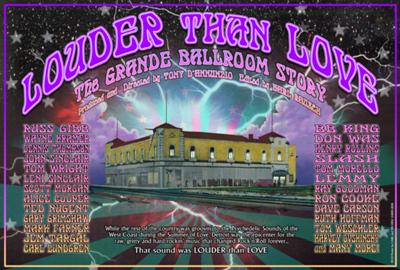
The Grande Ballroom Story - Louder Than Love


LOUDER THAN LOVE—
The Grande Ballroom Story
(Trailer)

LOUDER THAN LOVE is the story of the Grande Ballroom—birthplace of the Detroit rock music scene. Bands like MC5, Iggy & the Stooges, Ted Nugent & the Amboy Dukes, Alice Cooper and many more got their start here. The Grande not only influenced Michigan musicians but inspired bands from all over the U.S. and Europe. Legendary acts like Led Zeppelin, Cream, BB King, Janis Joplin, Pink Floyd and the Who graced the stage at the Grande on a regular basis.

(The last we heard, the producer is still seeking distribution funding for this film.)

Pink Floyd: Interlude For a Moon Landing, Opus 34

Today we were introduced to the work of phellow Floydian, Udo, who landed in Bernburg, Germany, sometime during the prior millenium. Wishing to reestablish contact with our Pink Floyd brethern, he writes:

"[Moonhead was an] instrumental piece used for a TV [program] on the evening of the first moonlanding—July 20, 1969. The program was used by the BBC in between coverage of the actual moonlanding and was called But What If It's Made of Green Cheese. The theme was the first verse and the coda, with various actors reading quotes and poetry about the moon over [the music]. The rest of the [program] was information, discussions and sketches. Later in the show, Moonhead was performed uninterrupted.


"The music can be heard on the bootlegs With/Without and Wavelengths. The song has also been known as Trip On Mars."

Our indebtedness to Rod Fender of the Trippy-Dippy-Hippies group (hosted by Yahoo) for calling this interstellar video transmission to our attention!

UPDATE: The Beeb's Apollo 11: A Night to Remember is scheduled to be released to DVD on June 29th! Since we haven't yet seen it, we cannot attest that it includes the Pink Floyd soundtrack, but believe it's certainly worth investigating.

Syd Barrett's Psychedelic London, Part II

Of Two Johns: Lennon & Sinclair, posted here a short while ago, tells of John Lennon, Pink Floyd, Soft Machine, and Yoko Ono all as active participants at The 14-Hour Technicolor Dream, an early London Be-In. Providing more detail of that story, Julian Palacios, author of the forthcoming book, Syd Barrett and Pink Floyd—Lost in the Woods, has graciously permitted an abridged chapter to be published herein. Click here for part one. Below is part two, reprinted here by permission:

The 14-Hour
Technicolor Dream

The 14 Hour Technicolor Dream marked the height of underground fashion. The full range of uniforms prevalent in sixties culture was in evidence. Here a phalanx of pea-coated beatniks, there a Kings Road fashion maven in a 1940’s satin dress with a chinchilla wrap. As proof of the Beatles sartorial dominance, everywhere were men with Edwardian beards and moustaches, rather than bog-brush beards of the later sixties. John Lennon grokked the scene clad in a sheepskin Afghan coat and granny specs.

The Pink Floyd made their way back from Heathrow. Stopping in at Edbrooke Road, [Peter] Jenner and Syd [Barrett] each dropped a tab of LSD before driving up to Muswell Hill in a convoy of Bentley and Transit van. Jenner said, "The most psychedelic experience that I’ve ever been to. At least half the audience was doing acid. I was doing acid. We’d had to take a long drive to get there from a gig in The Netherlands."

The group alighted at the Alexandra Palace at 3 am. They, like all the other bands, were playing free for the benefit. Syd wandered the crowd, tripping on LSD, having already smoked strong weed in Amsterdam earlier in the day. [He] ran into Mick Rock. The pair climbed scaffolding to peer into pipe organ bellows and entertained themselves pelting Yoko Ono with bits of wadded up paper as she organised a Fluxus-style happening. With a working title of "A Pretty Girl is a Manifesto," Ono had model Carol Mann [seated] on a stepladder dressed as a nun under a blazing spotlight. Audience members were handed scissors, outfitted with a contact microphone plugged into the sound system. Instructed to snip off her clothes, bit by bit her clothes fell away, as a crowd of bemused male punters swarmed. Amplified scissors echoed across the Palace until Mann sat, in all her glory, nude.

When Soft Machine took the stage, Daevid Allen wore a miner’s helmet with lamplight atop, Kevin Ayers sported oracular makeup. Robert Wyatt cut his hair short, wore a suit and tie, and set drums sideways. The group played [the] joke number We Did It Again, which repeated the title over one monotonous groove for 40 minutes at a stretch. Barrett soon adopted this avant-garde prank onstage to his band mates despair. ("Soft Machine were good fun," in Barrett’s view.)

Continued...

Daevid Allen said, "After we had finished I wandered about among the huge crowd." Allen also noted that, paradoxically, he never felt more alone in his life. "As this realization took hold of my entire being, I became aware of a celestial orchestra playing over a slow beat. I was drawn to the far stage where, unopposed by a simultaneous band, a group of slightly embarrassed musicians played symphonic slide guitar under the camouflage of vividly hypnotic light projections. The music thus created was almost Wagnerian in its emotional power. It welled up, expanding through the swirl of liquid light." A life changing moment for Allen, who adapted Barrett’s glissando technique, refined over a 40-year stretch with various incarnations of Gong.

Robert Wyatt was also impressed, "The Floyd played at 4 in the morning. It must have been one of the greatest gigs they ever did. Syd played with a slide and it blew my mind. I was hearing echoes of all the music I’d ever heard, with bits of Béla Bartók and God-knows-what."

The Pink Floyd at the Dream was the high point of the psychedelic era to Peter Jenner. "A perfect setting, everyone had been waiting for them and everybody was on acid." To a fanfare of the Finale by Bream, the group took the stage. Colin Turner was on hand, "The dawn arrived in a triumphant pink hue, the light came cascading in from the huge windows. Amid this awesome display of nature, Pink Floyd took the stage. They were wearing outfits with flared trousers and satin shirts. People began to awake and hold hands as the first notes of Astronomy Dominé echoed through the Palace."

Colin: "There was an extraordinary connection between the group and the audience. Then the magic happened. Syd’s mirror-disc Telecaster caught the dawn’s pink light. Syd noticed this and with drug-filled eyes blazing, he made his guitar talk louder and louder, higher and higher as he reflected the light into the eyes of his audience and christened those of us lucky enough to be there followers of Pink Floyd for life."

Chris Beard, "Something was not right and Syd was not up to it, just standing there out of his tree I suspected. Roger Waters seemed to take over. I admired Waters for this and was not happy that Syd had now drifted off." In a photograph, Barrett looks as though viewing things from a slight remove, as though already absent. Acid accentuated his offbeat charisma, such that he seemed in retreat even as the group approached fame.

As morning broke, sun streamed through the tall windows, lighting up the Palace in ghostly white angles. Brian Jones of the Rolling Stones, arriving a bit late, pulled up in Bentley and emerged looking rather shattered, clad in a full pearly king outfit. Beck’s Bolero by Jeff Beck blasted through the Palace, with Indian modal scales colliding head-on with Elmore James and Maurice Ravel’s Bolero. Hoppy and Suzy Creamcheese stood at the door. In inimitable style, they shook hands and said good morning to everyone as they filed out into the light. Hoppy’s court trial was four weeks away.

[International Times] summed up, "The beautiful scene at the benefit at the Alexandra Palace on the 29th seems long ago when considered in the light of all that has happened since then." Nick Jones wrote in Melody Maker, ‘The audience were happy looning about, looking at other’s clothes, eating, sleeping, dancing and just freaking out, doing whatever they damn well wanted. I found the Dream a most absorbing experience.’

Hoppy says, "The Dream was a crest of a wave. It was a landmark event. Everyone involved has a different story. All are true. It’s one of those paradoxes. The 14 Hour Technicolor Dream is a prime example of how memory gives the opportunity for many people to claim it was their event. Everyone can claim a piece, if they feel it important. Everybody thinks they know what the Dream was about, but when you look, there is something that you cannot find out about it. The 14 Hour Technicolor Dream is a cultural memory. It’s hidden and occluded." An accurate summary of the acid experience.

From Amazon.com: Syd Barrett was an art school student when he founded Pink Floyd. Famous before his 20th birthday, Barrett led the charge of psychedelia onstage at London’s famed UFO club, and his acid-inspired lyrics became a hallmark of London’s 1967 Summer of Love.

The second edition of Palacios' Syd Barrett and Pink Floyd—Lost in the Woods, from Plexus Publishing Ltd.—completely revised, expanded and amended—will be available in time for Christmas, 2009.

Audio Editing: From Razor Blades To Cut 'N' Paste

Regardless of any audio editing software you may try, these applications pretty much function the same way. Through simple trial and error, in no time you’ll soon be amazed by your newly-acquired power over your music collection or original audio recordings. Creating your own medleys is just one idea.

It wasn’t always this easy. As a teen in 1968, it was through being a Stereo Review subscriber that I learned how to edit ¼" audio tape using a slicing block and a razor blade. Knowing my penchant for electronics, my best friend asked if I could help him put together a soundtrack for a multimedia project he had taken on for his humanities class. I had a monaural Wollensak (3M) tape recorder but, knowing that this project would need more capability, I borrowed a Sony stereo deck. It had sound-on-sound (a recording technique invented by Hall of Fame guitarist Les Paul to allow pseudo-multitracking)—a technological advancement relatively new to the home market. Not having the foggiest that famed producer Sir George Martin and engineer Geoff Emerick had used this same technique to record the Beatles’ Rubber Soul, Revolver, and Sgt. Pepper’s Lonely Hearts Club Band (on a lowly four-track machine, no less!), I “bounced” audio snippets from machine to machine and spliced tape segments until we had a compilation about which my friend was well pleased. (Of course, his teacher had no comprehension regarding the ingenuity and creativity we poured into this term project.)

Wanting to become a rock DJ like those at trendsetting WABX and WKNR-FM I had emulated, off I went to Specs Howard School of Broadcast Arts after high school. All the while I dabbled in amateur audio production at home to amuse friends and myself. Meanwhile, another buddy—a highly-proficient rock guitarist who played in a covers band—had taken a recording engineer position at Ron Rose Productions. I’ll never forget one visit there after hours when I got to try a new effects gizmo that made me sound like Darth Vader! Today this same effect can easily be achieved through software.

Wolfgang's Vault - Reissue

Fast forwarding to today’s world of digital audio, when you rip a CD to your computer using software such as Windows Media Player, the result is an easily-editable WAV file—no more razor blades! Relatively easy to learn after a few minutes of trial and error, Syntrillium Software’s CoolEdit became the leading amateur tool of choice. (The company since acquired by Adobe Systems and the product renamed Audition, I almost took a testing job at Syntrillium in 2001.)

Later picking up a copy of Sony Sound Forge, with it I was able to easily able to edit Echoes, from Pink Floyd’s Meddle release, to remove a section I find unnerving. (Interestingly, a similar edited version appears on the group’s Best of CD that borrows this song’s title.) I also did the same with a Soft Machine favorite, Slightly All the Time, to get a better fit as one of the backtimed (a recording technique of cueing up a musical background to a voice track so that the music ends simultaneously with the voice-over) soundtrack choices for a Ken Burns-style vacation DVD I created a few years ago.

If the playback device is to be your MP3 player, once you’ve edited your WAV file it’s then a simple step to convert it to MP3 format using any one of a number of tools. Nero is but one popular choice for this task because many PC vendors provide it in the included free software bundle.

Audacity—an open-source editor—has become very popular with podcasters because it’s free and is well-supported by its devoted user community. YouTube even has many tutorials, such as this example on basic editing, to get you started. Even for those using another WAV editor, you may find these tutorials useful in that the principles are quite similar for most audio editing software.


Happy editing!

Syd Barrett 's Psychedelic London

Of Two Johns: Lennon & Sinclair, posted here a short while ago, tells of John Lennon, Pink Floyd, Soft Machine, and Yoko Ono all as active participants at The 14-Hour Technicolor Dream, an early London Be-In. Providing more detail of that story, Julian Palacios, author of the forthcoming book, Syd Barrett and Pink Floyd—Lost in the Woods, has graciously permitted an abridged chapter to be published herein. Here is part one, reprinted here by permission:

The 14-Hour
Technicolor Dream

That night the Pink Floyd topped the bill at multi-band extravaganza, The 14 Hour Technicolor Dream. Hoppy organized a group of his girlfriends to stand in Regent Street and pass out fliers, dressed in miniskirts ten inches above the knee. Later, the same flower and fancy dress contingent dropped off an invitation to the Dream for the Queen at Buckingham Palace.

Envisaged as a "giant benefit against fuzz action" of the sort that arrested Hoppy and tried to shut down [the International Times], The Technicolor Dream was to raise funds for the [IT] legal defence fund. Word of the event spread throughout London for weeks. An estimated 7,000 punters crowded into the vast Alexandra Palace in London, hired out for the night by Hoppy and Dave Howson of Middle Earth.

The Alexandra Palace was a series of Victorian glass and steel halls built in 1875 crowning the top of Muswell Hill, overlooking London like an aerie. The Great Hall’s awe-inspiring vaulted roof and 30-foot tall glass windows surrounded space for 12,000 with 2,000 more in orchestra stalls. The colossal Willis Organ, driven by steam engines and vast bellows, was under scaffolding for repairs.

The Dream began at 8pm and went through the night until 10 in the morning. Many groovers had been up since the night before at UFO, when Jimi Hendrix jumped up to play bass with Tomorrow. [They] arrived in black ties, blazers, and evening dress befitting attending a cultural event. A generous assortment of caftan and bell wearing ravers flowed through them, bursting into the Palace in high spirits.


Continued...
For many, the Dream was an epochal experience, as a ripple of recognition spread through the crowd, amazed at how many full-fledged freaks were in London, and how many they knew. The small London coterie sent out a wave that affected youth culture the world over. The 14 Hour Technicolor Dream brought the movement out into the open, propagated core ideas, and imploded, in the manner of mass cultural movements.

Dudley Edwards of art ensemble Binder, Edwards and Vaughn says, "For anyone who was privileged to be there, that was the event of the sixties. The huge interior space was lit with big film arc lights turning night into day. There was a feel of a medieval market place with stalls and people in harlequin costumes, acrobats here and jugglers there, a helter skelter."

Paying one-pound admission at the door, crowds streamed into the Hall. The scaffolding around the pipe organ like a baroque reliquary, a battery of spotlights accentuated looming shadows. Three film crews filmed proceedings. Indica gallery owner John Dunbar was at John Lennon’s home that evening. "We were watching TV and suddenly saw this thing was going on. So we thought, [sod] it, let’s go! We ended up at this place where everybody I’d ever known in my life swam before my eyes at one time or another. All eyes were vaguely on us because we were with John and I literally saw people I’d last seen at kindergarten and hadn’t seen since."

Selmer were volunteered by Blackhill to provide a PA system. Two chaps came down from their factory and set up a pitiful 100-watt PA, with two 2 x 12 combos and Selmer Goliath bass cabinet on either stage.

For the better of the night and morning, two bands played simultaneously on the two stages, often causing an unexpected merger of styles though also a headache as sound resounded off the vaulted roof. Mick Farren, "I swear I saw Lennon standing in [the] zone of dissonance moving forward and back looking quite fascinated."

[David] Medalla and half a dozen nubile dancers in flowing scarves and gauze danced freeform pirouettes under powerful lights that cast stark shadows of the dancers across the assembled throng. To the tune of the Beatles’ Tomorrow Never Knows, they performed a ballet of sorts dubbed the "fuzz death ballet." Nightstick wielding bobbies chased nymphs and Medalla, with silver reflective discs like the ones on Syd’s guitar affixed to legs and bum.

Jack Henry Moore and a small army of technicians dashed from one spot to another, fixing speakers threatening to fuse and rewiring light fixtures on the verge of collapse. 500,000 watts of lightshows galore lit up every inch of available wall space from a light gantry in the centre of the Palace. Underground films were screened overhead. Projectors beamed onto billowing white sheets taped with electrician’s tape to the scaffolding housing the Victorian organ. The centrepiece was a 70-foot tall helter-skelter slide rented for the night, which people clambered to the top of and spiralled down.

The mood was optimistic, as smiling, colourful dressed people milled with endless chemical quicksteps from corner to corner. A ritual lighting of joss sticks filled the Palace with sickly sweet smoke. A wire igloo with mosquito netting was set up in one corner, where banana skin joints, touted for hallucinogenic effects, were handed out. A bitter after-taste was all it left one with, though the idea was more of an intentional put-on anyhow. Couples grappled in the igloo all night.

Announced by MC Jeff Dexter dressed as a cardinal, complete with robes and vestment, rock bands filed on and off one after the other. The acts included American black comedian/activist Dick Gregory, Yoko Ono, Notting Hill sound artist (and later Pink Floyd collaborator) Ron Geesin and Syd’s Camberwell classmate, Barry Fantoni.

Peter Russell and his lightshow team, attached to Cambridge band 117, occupied the top tier while [art ensemble Binder, Edwards and Vaughn] cast overhead watch glass projections on sheets ringing the Palace. 117’s shows used thin liquid films sandwiched between slides, using heat or pressure (and sometimes injection) to move them. Some early Polaroid work as well.’

Edwards descended from the scaffolding to take in the scene. "It was all so relaxed. Denny Laine was just sitting on the floor strumming his acoustic guitar with no one paying any heed. John Lennon and John Dunbar just strolled through the crowds without interference."

Though obstruction from the Musician’s Union blocked a performance by Frank Zappa and the Mothers of Invention, bands pile drove through to the dawn.

The freak contingent was well represented by hardcore underground band The Flies, whom Miles cited as the world’s first punk band. With vocalist Robin Hunt draped in a sheet stolen from the lightshow, the Flies launched into their ferocious freak beat version of (I’m Not Your) Stepping Stone. Like the Brothers Grimm, the Flies formed part of the UFO cadre that shouted the Pink Floyd had sold out.

The Crazy World of Arthur Brown made an electrifying performance with a sprightly Arthur Brown in full makeup prancing like a shaman on ayahuasca with headdress in flames, shouting "I am the god of hellfire!"

From Amazon.com: Syd Barrett was an art school student when he founded Pink Floyd. Famous before his 20th birthday, Barrett led the charge of psychedelia onstage at London’s famed UFO club, and his acid-inspired lyrics became a hallmark of London’s 1967 Summer of Love.

The second edition of Palacios' Syd Barrett and Pink Floyd—Lost in the Woods, from Plexus Publishing Ltd.—completely revised, expanded and amended—will be available in time for Christmas, 2009. Visit Floydian Slips again for part two of this story chronicling the emergence of psychedelia.

David Gilmour Live In Gdansk!

This appears to be an excellent new double DVD/double CD set from the last David Gilmour concert to feature the late Rick Wright on keyboards and vocals. Guitar cacophony at its best, Astronomy Domine is one of my all-time favorite Floyd tracks.

Click here for the background story on Astronomy Domine. And here the BBC reviews the DVD.

In memory of Rick Wright and Kay Seeburg.

Of Two Johns: Lennon & Sinclair

Last weekend we watched The U.S. vs. John Lennon. After the show, I told Joanna another Forrest Gumpian story from my past. No, I didn't teach Elvis his moves, but it's another of those Six Degrees of Separation things that amuse me to no end, especially since the degree of separation—for me, anyway—is usually two or three (four at most).

Walking past the smaller of the two school gynasiums one afternoon in 1968, I heard the coolest music playing from within. I stepped inside and, inquiring of my English teacher, Dave Lundin, learned that I was hearing Upper & Lower Egypt from Pharoah Sanders' Tauhid LP.

More important, Dave told me he was setting up the gym for a be-in, to occur that Saturday night and would I like to participate? Sensing that this was something not to be missed, between the two of us we agreed I'd stage a shadow show during the goings on.

6/21/09—This just in from John Sinclair, London, England:

Thanks for the warm memories and the
nice post. Dave Lundin, what a great guy

Love, John

(Only 40 years later did I learn that Dave had been a regular at Wayne State University's infamous Cass Corridor, where he was picking up counterculture influences and importing them to the NW Detroit suburbs for those emulating the Cleaver family in the post-Eisenhower era. About the same time I discovered that Yoko Ono had been an early participant in both Manhattan, then London, be-ins, such as The 14 Hour Technicolour Dream held at the Alexandra Palace to the music of Pink Floyd and Soft Machine. But more on the Yoko connection later.)

At home I dug up all sorts of small treasures for the shadow show which, as it turned out, I performed onstage adjacent to the 10,000 megawatt, 150 decibel, full-on assault of the legendary MC5, followed thereafter by the jazz grooves laid down by the Charles Moore Ensemble. For a good portion of the evening, band manager, poet, musician, Fifth Estate music columnist and White Panther co-founder John Sinclair—attired in vertically striped green and white pants—was prancing around like a leprechaun on an elevated walkway, handing out cinnamon sticks to all those in attendance.

Facing a ten-year sentence, Sinclair was shortly sent to the Michigan State Penitentiary for possession of three joints. After first talking to Lundin about the idea, I wrote to Sinclair and received a very nice reply shortly thereafter. He was obviously very happy to hear from anybody on the outside. Too bad I didn't save his letter!

"The people at Woodstock really were a bunch of hypocrites
claiming a cosmic revolution... while John Sinclair
rotted in jail after a trumped-up drug bust."

Pete Townshend, from The Road to Woodstock by Michael
Lang with Holly George-Warren, Ecco/HarperCollins, © 2009

Two years later "the stars aligned" for the John Sinclair Freedom Rally at Ann Arbor's Crisler Arena. Having been involved on the fringe of radical politics in the U.S. for some time, organizers were able to enlist the aide of none other than that other John—late of Beatles fame—along with his ever-present other half, Yoko Ono. Also about this time Lennon had recorded the song, John Sinclair, released on his Some Time in New York City album. Sinclair was freed and the city of Ann Arbor soon reduced the fine for smoking marajuana to a paltry five dollars.

Another Brick In the Wall—DVD Review

Although this blog is named in honor of the Floyd and I had previously viewed snippets, last night marks the first time I've ever seen The Wall in its entirety—though it's been around for 25 years. Perhaps I was waiting for my own big screen, surround sound home theater. Perhaps not.

I don't need to prove my fanhood here; previous blog entries attest to my involvement with the band's music—Saucerful of Secrets having been a defining listening experience that permanently juggled my neurons. So those who were first indoctrinated to Pink Floyd through Dark Side of the Moon and/or The Wall may take me to task, but comments made by Mssrs. Wright and Gilmour lead me to believe they feel pretty much the same way. For, as keyboardist Rick Wright had posted on MySpace:


I'd like to meet a bassist (who) doesn't write songs about his dad all the time.
I believe it was in Nicholas Schaffner's excellent Saucerful of Secrets: The Pink Floyd Odyssey where he reported David Gilmour was in regular battles with Roger Waters about the musicality of the the latter's work. It was Gilmour, then, who insisted that their recordings include a melody component—something to which Waters apparently wasn't, uh, attuned.

In listening to this work all the way through, it became clear why I never rushed out and bought this LP, having also been deeply disappointed by their prior effort, Animals. While Waters may be a terrific poet (and I believe him to be, especially after viewing the extra bits last night), Gilmour is much more the musician of the two, with an able assist from Wright in plotting the notational direction.

Assessing the music of The Wall, there are roughly four tracks that truly qualify as music I like to hear on a repeated basis, and—guess what—they're all Gilmour. And this is pretty much historical running backwards through their catalog.

BUT...about the movie. As all those interviewed pointed out, The Wall was very much a collaborative work of art, extending far beyond Waters' initial ideas. His reaching out to Gerald Scarfe for the live stage visuals, then later the movie, was an inspired choice. And Sir Alan Parker, as director, made an outstanding contribution, as did the cinematographer, the choreographer, and on down the line. Exploring first the inner turmoil of those having attained stardom, coupled with the alienation imposed on us all through our existence as humans ("How can you have any pudding if you don't eat your meat?"), The Wall works as a very creative artwork. But is it entertainment?

During the included interview, Waters remarks that what the film lacks is humor—a key component to his work, he insists. (One wouldn't know it from listening to the Waters-penned Animals). In fact, he felt the film ran too long, which explains why Hey You—one of the more listenable tracks—was cut out of the movie (but added to the DVD as an extra bit).

The Wall's fascist rally scenes were particularly interesting in relation to whose idea it was to include them, Waters stating that he didn't provide the seed. Disturbingly, I saw myself in the crowd, exuberantly expressing my enthusiasm for anything eminating from the stage! How many times has each of us had that experience, with the performers either going through the motions or openly displaying their hostility toward the audience? Having been on the road for seven years as a seminar speaker before hundreds at a whack, I can relate. My guess is that, although it appears he denies it, there's more ownership to these scenes than Waters takes credit for. I wonder if his former bandmates might agree?

There Is No Dark Side of the Moon, Really

Mo' Background

Last week I received a bluesky e-mail from a fellow who was trying to track down a former flame—one Kay Seeburg, she of the jukebox family. He had Googled her name and, lo' and behold, up came a post I had made on Radio Paradise in reference to Pink Floyd's Remember A Day. The track is from their second LP, A Saucerful of Secrets, which she thought was the funniest LP title ever. Don't ask me why.

The title of this blog comes by way of the Floyds. Being a HUGE fan of theirs from that LP forward (save for the Animals atrocity), it always amazes me to find listeners—like you, perhaps—who have no inkling of what transpired prior to their epic DSOM (Dark Side of the Moon, for the uninitiated). Sure, that seminal LP sat on Billboard's charts for-freakin'-ever and, though I haven't checked, I'm pretty certain it set Guinness Book records (humor, ar-ar).

So if you have an incination, in addition to the aforementioned Saucerful, may I suggest for your listening pleasure the following: Ummagumma, Atom Heart Mother, and More. The latter is a very obscure soundtrack the Floyd did for a highly-forgettable movie, though their contribution is outstanding. (The Floyds also recorded another soundtrack, Obscured By Clouds, but only overzealous Floyd freaks need track this one down.)

Some of my running buddies also like Meddle, as do I, though I can only listen to the version of Echoes that I edited using Sony Sound Forge. (I understand the track that appears on their Echoes: The Best of Pink Floyd CD by this name is essentially the same as my edited version.)

And for you Netflixers, see if you can spot one pre-Lennonesque Yoko Ono in Pink Floyd: London 1966-1967. This rare footage features the band with founder Syd Barrett, performing a pre-Piper At the Gates of Dawn version of Astronomy Domine, as I recall. Maybe it was Interstellar Overdrive, I dunno. Watch the DVD: you'll enjoy seeing what the mid-60s Carnaby Street crowd was up to after hours.

So if you only know of Pink Floyd by way of DSOM and The Wall, you've got a LOT of terrific listening ahead of you. And David Gilmour's On An Island is also highly recommended!

Wish(ing) You Were Here