Showing posts with label Grande Ballroom. Show all posts

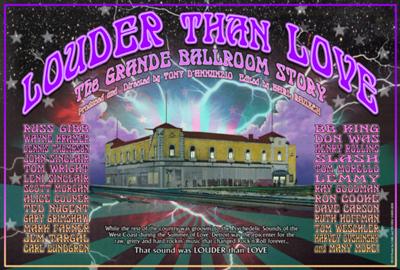
The Grande Ballroom Story - Louder Than Love


LOUDER THAN LOVE—
The Grande Ballroom Story
(Trailer)

LOUDER THAN LOVE is the story of the Grande Ballroom—birthplace of the Detroit rock music scene. Bands like MC5, Iggy & the Stooges, Ted Nugent & the Amboy Dukes, Alice Cooper and many more got their start here. The Grande not only influenced Michigan musicians but inspired bands from all over the U.S. and Europe. Legendary acts like Led Zeppelin, Cream, BB King, Janis Joplin, Pink Floyd and the Who graced the stage at the Grande on a regular basis.

(The last we heard, the producer is still seeking distribution funding for this film.)

Freeform Radio Master—Dave Dixon On WABX

It was 1967 and, if we were lucky, once in a great while we might hear something cool on AM radio—Buffalo Springfield’s For What It’s Worth being a harbinger of what was to come. In the autumn of that year, Detroit’s WABX-FM began broadcasting The Troubador, an experimental show, for an hour each week.

For the first time we could listen to an eclectic mix of blues, rock, folk and jazz all within the same program. And in stereo, no less. Within six months the X was broadcasting similar programming for most of each day. For this listener, there was never any looking back at the limited, uneven, preformatted AM station offerings we had had to endure up to that point. (Remember the Zombies being followed by Percy Faith?)

As an impressionable 15-year-old music hound, I would frequently call and have lengthy conversations with the DJs while ostensibly doing homework. John Small, who soon moved over to WKNR-FM, was always very welcoming. Then ABX added Dave Dixon to its staff; he would go on to become the esteemed leader of the legendary "Air Aces."

Dixon had a “golden ear,” introducing attentive listeners to cross-cultural music on a world scale. Only on his show could one be exposed to such gems as Paul Horn’s Inside the Taj Mahal, Gandharva from Beaver & Krause, Richard Harris singing MacArthur Park and Harry Nilsson’s The Point (a complete LP side). In between, he might have mixed in a cut from John Mayall’s Blues From Laurel Canyon, some Savoy Brown (with original vocalist Chris Youlden), Cat Mother & the All-Night Newsboys and a track from Tim Buckley’s Happy Sad release. Toss in some Brian Auger Trinity (featuring Julie Driscoll on vocals) and Laura Nyro singing Eli's Coming for good measure. Not to be overlooked, Detroit artists such as Frost (Dick Wagner), the Amboy Dukes (Ted Nugent), SRC and the Stooges (Iggy Pop) would also be integrated into the mix.

Continued...
Often Dixon wouldn’t play an entire track. Instead he would seamlessly blend portions of disparate genres into a cohesive audio excursion that might last an hour, interrupted only for a FCC-mandated station ID break. His instrument was comprised of matching turntables, a mixing console and a headphone set.

I miss the days when I was INFORMED [about] new
music… even the music I didn't like I grew to appreciate
for its uniqueness. It was truly an education back
then… How will [this generation] expand [its musical]

horizons?? Surely not from corporate radio stations.

Smogboy, from At Detroit forum, 12/10/06

During his career Dixon was fired from more than one station, being labeled as gruff and argumentative. While that very well may be true, to this listener—and frequent caller—he always had time to talk about music, share what he knew, and be an encourager. This was perhaps most important, for I had started on a voyage of musical discovery long before Dave Dixon and WABX, and wondered why others didn’t seem to find music as important to their daily existence. Instead of snuffing out that desire, his unique ability as audio interpreter, alchemist and promoter fortified my quest to be ever on the alert for recordings of interest.

Today the closest one can get to freeform programming in this style rests with college radio stations having limited range, unless they're also streaming on the Internet such as WNMC in Traverse City, Michigan. While it doesn't quite match Dixon's artistry, the Internet's Radio Paradise does a credible job of filling the void left by the demise of freeform terrestial radio. (Albeit Dixon's shows were sometimes extraterrestial.)

Dixon left ABX in 1974. After 10 years in the Miami/Ft. Lauderdale market, he returned to Detroit, where for several years he played the same type of unique music mix on public station WDET as he had during those heady days of the “Air Aces.”

Listen to a 1990 Dave Dixon aircheck while he was on WDET:

After a few years doing a talk show on WXYT in Detroit, Dixon died at home in May of 1999 at age 60. His legacy is that of programming shows in the way that a painter chooses colors and textures, painstakenly and deliberately applying them on an aural canvas to provide much more than a fleeting impression.

Pharoah Sanders Quartet In Concert At Yoshi's

Regular Floydian Slips readers probably know we've been lifelong fans of jazz saxophonist Pharoah Sanders since first hearing Upper and Lower Egypt off of his Tauhid release. In 1999 he remarked that, due to his musical pedigree—including a stint in Sun Ra's Solar Arkestra—he had been unable to get sufficient bookings back in America. Sanders is also known for dueling horn-to-horn with the great John Coltrane. Having established all of that, we were ecstatic to finally catch up with him in concert.

(Sun Ra's Arkestra had once played Russ Gibb's Grande Ballroom in Detroit at the behest of MC5 manager and White Panther Party founder John Sinclair.)

On this tour Sanders is playing with renowned Indian tabla player Zakir Hussain, who has previously collaborated with guitarist John McLaughlin on his Shakti projects and Grateful Dead drummer /percussionist Mickey Hart on several ethnomusicology endeavors. In 1991 a Planet Drum collaboration of Hart and Hussain's won a Grammy Award in the then-new Best Contemporary World Music Album.

We're fans of McLaughlin and Hart, but—not having heard too many Shakti and no Planet Drum recordings—didn't know Hussain. But two friends, Ram and Bharath, knew Hussain's music well in their home country of India, where Hussain is also a musical producer, film actor and soundtrack composer. To make things interesting, neither had ever heard of Sanders prior to joining us at Sunday's concert.

[He's] probably the best tenor player in the world.

Ornette Coleman

Bharath: I read up about Pharoah Sanders and his music on the the Internet prior to the event. Zakhir Hussain is a legend who is peerless when it comes to playing the tabla. It was because of him that I was really looking forward to the event. I wasn't sure how well Hussain and Sanders would come together playing their instruments, since it seems difficult to blend tabla music in a jazz setting. Once the concert started, it became difficult to appreciate Hussain's tabla whenever Sanders was playing. Whenever the saxophonist took breaks, however, Hussain and the rest of the ensemble were able to highlight their music. Hussain was both really energetic and innovative (using different instruments), but I left with the impression that his strength is still Hindustani or Carnatic music and not really fusion music (at least not in the jazz realm). Overall he was much better performing solo or with drummer Joe Farnsworth in this context.

Listen to these Pharoah Sanders' tracks in their entirety:

ThembiAstral TravelingUpper & Lower Egypt

Ram: I'd never seen the great percussionist Zakhir Hussain perform, but every kid in my neighborhood knew of him growing up—initially through Taj Mahal tea ads, then later by listening to him on the radio and TV. I was intrigued with the notion of jazz with tabla, not to mention a trip to the city and sushi on top of that. Yoshi's is cozy yet not too small, providing a great view from almost anywhere in the house. Starting promptly at 2 pm, after ten minutes into the matinĂ©e Sanders left the stage and each sideman got a chance to solo. Upon returning, Sanders took to vocals and his sax, inviting the audience to sing and clap to music that was absolutely captivating. He even danced on occasion! The only difficulty was in hearing Hussain's tabla, which was almost inaudible during this portion. After this the musicians soloed again, followed by a jugalbandi between Hussain and Farnsworth. All in all the show was fantastic; the only downside being that it perhaps ended too early.


Chris: Pharoah Sanders could do no wrong. If all I was able to do was to say hello and let him know of my passion for his music since first hearing it 40 years ago, that would have been sufficient. Two nights prior to the concert, I streamed a film about Neal "On the Road" Cassady from Amazon. What did the producers choose as a music bed for one scene but Sanders' Upper & Lower Egypt, from the same Tauhid album that willingly pulled me in to his music. In the way that consciousnesses inexplicably converge, I truly sensed some foreshadowing going on.

Having heard "Toots" Thielemans at the original club in Oakland, I was enthralled just to be at Yoshi's in San Francisco on a sunny Sunday afternoon. Not only did Sanders' oblige with a pre-concert photo of the two of us, I know I was smiling throughout his performance. One moment he's very melodic, then he honks a note or two reminiscent of a charging rhinoceros. A tip 'o the hat also goes to William Henderson, who provided oustanding accompaniment on piano.

Rocking At the Red Dog: Psychedelic Age Begins

Planting the Seed(s) of the Psychedelic Age

We've been doing a lot of research as of late, using the '67 Summer of Love as a focal point. Arriving late to the party, what George Harrison saw disturbed him as he played street minstrel to thousands. His first-hand summation was amplified by PBS's American Experience worthy retrospective presented 40 years later (view it online for free). All of the sour grapes makes Floydian Slips glad we didn't accept Dr. Tim's admonition to tune out—not completely, anyway. (Tuning in and turning on were suggestions more easily accepted.)

The Beats aside, what's not well-known is the real backstory to the burgeoning Haight-Ashbury scene before the tour buses put the district on a freak show site-seeing route. It starts two years earlier, with the opening of the Red Dog Saloon in the unlikely location of Virginia City, NV.

The story gets two pages in I Want To Take You Higher—The Psychedelic Era 1965-1969, a magnificent coffee table volume issued by the Rock 'N' Roll Hall of Fame and Museum. As worthwhile as this volume is for any collector's library, the complete story is best told in Rockin' At the Red Dog—The Dawn of Psychedelic Rock. The expose that Life magazine missed, this comprehensive video includes rare photos, original footage of a pre-Janis Joplin Big Brother and the Holding Company, and interviews with many of those who were an integral part of the scene.

The best documentary on the ‘60s
ever made. Red Dog Saloon rocks!

Michael SimmonsRolling Stone, L.A. Weekly, High Times, BAM

The Charlatans get a lot of attention for reasons best told by the video, an obvious labor of love for Director Mary Works (Assistant Editor, Titanic, Saving Private Ryan). Other groups included in the piece are Quicksilver Messenger Service, Grateful Dead and the Jefferson Airplane, although the viewer should not expect them to be a focal point. Rather, Rockin' At the Red Dog is really the story of how a handful of people began a cultural revolution that spread across America in a few short years. Interesting sidenotes include noted poster artist Anton Kelly on the advent of rock posters, and a look at Bill Ham's development of the de rigeur psychedelic light show.

Wolfgang's Vault - Reissue

It should be noted that, without the Red Dog's pioneering trailblazers, there very well may never have been an Avalon, a Fillmore, a Winterland, a Grande Ballroom, a Boston Tea Party, a Monterey Pop Festival, or a Woodstock. Netflix subscribers may instantly view this entertaining documentary; others may stream it over the 'Net using Amazon's Video On Demand service for a nominal fee.

The Spirit of Randy California

In the Company of Jimi Hendrix

The date was late July, 1969. We've been flashing back to the Grande Ballroom, where Spirit topped a bill that included one-hit wonders Fever Tree (San Francisco Girls (Return of the Native)). Led by guitar whiz Randy California, Spirit had debuted their first album that past January, with one track, Fresh Garbage, in regular rotation on Detroit's underground rock stations.

Free! Listen to Topanga Windows
in its entirety. Download it here (99¢).

Alas, it being the '60s we don't remember too much about this concert, other than being enthralled to hear such an iconic rock group at that magical venue. With Jay Ferguson, Mark Andes and John Locke joining California and his stepfather, Ed Cassidy, Spirit's music was an inventive mix of fusion of jazz, rock, folk and blues, liberally sprinkled with psychedelia.

The Doors were all right—but for many rock fans in the
late 60s, the band that really mattered was Spirit.

Critic Jim Washburn, Los Angeles Times

Just two years before this concert date, guitarist Randy Wolfe had moved to New York with his mother and jazz drummer Ed Cassidy, the elder having at one time played with Dexter Gordon, Cannonball Adderley, Rahsaan Roland Kirk, Les McCann, Gerry Mulligan, Mason Williams, Taj Mahal and Ry Cooder. Already a prodigious guitar player at 16, it was at Manny's Music in Manhattan that Wolfe met Jimi Hendrix, subsequently joining the latter's Jimmy James & the Blue Flames in 1966. There being another Randy—a Texan—in the band, it was Jimi who rechristened Wolfe "Randy California," apparently to help the band leader distinguish between the two. And when Hendrix was called to London by Chas Chandler to ultimately form the Experience, California's parents made him forego that fork in the road so he could finish high school stateside.

In '68 Spirit was backed on tour by Led Zeppelin. Many accounts cite that, in creating Stairway To Heaven, the Zep's Jimmy Page borrowed the key riff from Spirit's Taurus—charges that Page denies. California ultimately penned all of Spirit's hits, including I Got A Line On You, 1984 and Nature's Way.

A month after Spirit's '69 appearance at the Grande, Hendrix was scheduled to play Woodstock. Not forgetting his old friend, California was asked if his group would like to appear before him. The idea was nixed by the Spirit's manager, Lou Adler (co-producer of the Monterey Pop Festival two years earlier), with this short-sightedness ultimately preventing the band from achieving the level of success it should have easily attained.

Spirit's The Family That Plays Together was an impressive follow-up to the group's debut recording, but it was their fourth album, The Twelve Dreams of Dr. Sardonicus, that ranks highly on many "Best of the Era" lists. With good reason, too: it's one of those rare recordings that is consistently great from start to finish. The band continued to languish, however, causing Ferguson and Andes to soon cast their fate with Jo-Jo Gunne (the band's name lifted from a Chuck Berry song).


Various Spirit incarnations came and went over the next several years, Cass being the only original member to remain. After several solo projects, ultimately his step-son rejoined. Recorded at Milwaukee's Summerfest festival, the Spirit In Concert DVD has Scott Monahan (keyboards and vocals) and Walter Egan (bass and vocals) joining co-founders Cass and California. The audio recording quality is sub-par, but this DVD clearly displays the exuberant showmanship of California and the Thor-like power of Cass on the drums. Floydian Slips recommends renting this video for its "feel good" entertainment value alone.

Like the Beatles and Pink Floyd, don't hold out for a Spirit reunion featuring the original lineup. John Locke passed away in 2006 and California drowned in Hawaii while rescuing his son from a riptide in 1997. Thankfully this one video exists of California in his prime, and the Spirit back catalog continues to be available.

Clapton, Winwood Play Madison Square Garden

Having seen Cream play at Detroit's Grande Ballroom in the autumn of '67, like many fans I was disheartened when they disbanded. Also being a fan of Steve Winwood's Traffic, my excitement was quickly renewed when I learned that Eric Clapton and Ginger Baker were teaming up with Winwood to form Blind Faith. Their one and only album shortly hit the streets in August of '69.

That fall I saw them at Olympia Stadium (then home of the Red Wings)—the worst venue ever at which to stage a concert of any sort. The warm-up acts that night included one-hit wonders Friend & Lover (Reach Out of the Darkness), followed shortly by Delaney & Bonnie and Friends. Yes, I had reserved seats, but because the stage was set "center-ice," mine faced the rear of the band's speaker columns! Only on occasion would my heroes duck around between their Marshalls to play a few bars for us poor sods relegated to the "low-rent district." (As the promoter of this fiasco, you owe me one, Russ!)

With the exception of paying the big bucks to see Paul McCartney at "Echo" Arena a few years back in Sacramento, I've managed to steer clear of the large indoor "concert venues"—instead enjoying arena rock on my 52" video/surround sound system. So preferring my couch-potato venue for the really big acts, to my delight Steve Winwood was the featured end-of-show performer at Clapton's 2007 Crossroads benefit concert held outside of Chicago. First performing many of Traffic's chestnuts as a frontman, he then teamed up with the concert host to perform several Blind Faith numbers.

I had seen advertisements for the current Clapton~Winwood concert tour online, but had no idea—until today—that a DVD release of their February Madison Square Gardens tour stop was in the works. Among many others, tracks include Had To Cry Today, Dear Mr. Fantasy, Pearly Queen, Tell the Truth, After Midnight, and Voodoo Chile (for which Winwood played keyboards on Hendrix's original Electric Ladyland release).

PBS will be broadcasting this terrific performance in June, so check your local TV listings. Below is an amateur video from that event featuring the rocks legends' version of Hendrix's Little Wing. While it gives you an idea of what to expect from both the video and any forthcoming live concert of theirs, please remember that this sample is not at all representative of the quality provided by the authorized DVD. Enjoy!


Tim Buckley & The Grande: Motor City's Burnin'

In the turbulent summer of July, 1967, folksinger and Elektra recording artist Tim Buckley was booked to play Detroit's Grande Ballroom, run by "Uncle" Russ Gibb. Back in the day, it was not uncommon for musicians to accept Gibb's invitation to stay at his place while in town. So it was that Buckley and his Afro-American drummer, Carter Collins, found themselves at a Sunday picnic organized by their host and held at Kensington Metropolitan Park (to the northwest of Detroit along I-96).

Returning from their day outing, the three surprisingly found the streets blocked when they got to the intersection of Greenfield Road and Grand River Avenue. It was then that the police informed them that parts of the city were in flames, that it was unsafe to proceed past the boundary at Eight Mile Road that had been established by the National Guard.

"Holy crap," Buckley and Collins exclaimed, "We need to fetch our gear from the Grande!" All three knew that the venue was located near ground-zero and could possibly be torched. Collins had stashed his drum kit there, while Buckley had left a few priceless guitars.

Russ being the local, he circuitously navigated his Thunderbird first through the white neighborhoods, then on into those which were primarily black. At this point Collins took the wheel, with Buckley and Gibb crouched down very low between the front and rear seats.

Now approaching the Grande, Collins flagged down a young black kid and—the ballroom being unscathed amongst the flames everywhere else—pointed to the Grande. "Hey, man...what's going down? How come that place still standin'?" The young boy replied, "Oh, dey got MU-sic dere."

So it was that the Grande Ballroom—having hosted such acts as Muddy Waters, Albert King, (Detroit's own) John Lee Hooker, Howlin' Wolf, B.B. King, Buddy Guy, the James Cotton Blues Band, and the Chambers Brothers—escaped the infamous '67 riots. It was a regular protocol—long established by Gibb—to let the local black kids in for free. He had figured that if they were inside enjoying themselves, they weren't outside breaking into patrons' cars and/or accosting concert-goers outside the venue.

"Uncle" Russ Revisits The Grande Ballroom


Left: Russ back in the day


Below: Russ talks about the Grande Ballroom in these two videos (click
to play).


Led Zeppelin: "Roadwork" Visits The Grande

Probably one of the best books about rock 'n' roll you'll ever see.Pete Townshend

Shortly after WKNR's owner, Nellie Knorr, passed away, I got one of those "blue sky" phone calls from "Uncle" Russ Gibb (the latter being chronicled elsewhere in this blog). Among the topics of discussion was Russ' mentioning to me of Tom Wright's terrific photojournal, Roadwork—Rock & Roll Turned Inside Out.

Wright was the official photographer of The Who's first couple of U.S. tours, that group having debuted their Tommy rock opera at Russ' Grande Ballroom in Detroit. When one early tour came to an abrupt end, Tom returned to the Grande to take a turn as its manager. Later, he was instrumental in constructing the buildings for Richard Songer and Russ' Goose Lake International Music Festival (for which I serendipitously served on the film crew). Later, Wright toured with and photographed other rock groups, including Rod Stewart & the Faces.

One very amusing story came out of Wright's stint at the Grande, involving the "The New Yardbirds" (you may know them as Led Zeppelin). Surf over to this National Public Radio site, where you can also hear an interview with Wright. The story I allude to is further down the page and is entitled, Chapter 17: The Grande.

Soft Machine Upstage Jimi Hendrix

Room Full of Mirrors (Slight Return)

This is an e-mail I sent to author Charles Cross in 2006 while reading his Room Full of Mirrors: A Biography of Jimi Hendrix:

"This is an interesting book. I picked it up to learn more about Jimi's relationship with Miles Davis, of which there are differing accounts of what actually transpired. In Miles' own autobiography, he never mentions the three-way deal with Jimi and Tony Williams, but only tells how they were due to get together on a project immediately after the Isle of Wight. Of course, I believe Miles may have conveniently omitted the business of wanting $50K from Mike Jeffrey before moving ahead with the Miles-Jimi-Tony project mentioned in your book.

"The Jimi at Cobo Arena (Detroit) concert, sponsored by radio station 'Paul Is Dead' WKNR, apparently took place in November of '68. I had seen the Experience at Detroit's Masonic Auditorium, with Soft Machine (also managed by Jeffrey), nine months prior. Jimi was having one of his off nights, was in a foul mood, and there was no encore, as I recall. I was extremely disappointed in his performance that evening.

"On the other hand, Soft Machine absolutely blew me away, between their music and fabulous light show. In letting "Uncle Russ" Gibb know how much I enjoyed that group during one of my regular calls to him while he was on the air, he invited me down to Keener in Dearborn [MI] to pick up an advance copy of their debut album on a 7" tape reel. This I did, with that story being chronicled at the above-referenced URL [and as an earlier blog entry].

"I haven't yet read the final chapters and the story of Monika Danneman. If you subscribe to Eric Burdon's theory laid out in his memoir, she was a psycho who dosed Jimi with extremely powerful German painkillers in an effort to keep him in her nest. Burdon also had issues with Mike Jeffrey regarding his mob ties, both in the U.S. and U.K."

[Interestingly, I recently learned that Andy Summers, guitarist with the Police, had been both a one-time member of Eric Burdon's New Animals and Soft Machine. Alas, he had been sent packing from Soft Machine before their Hendrix support tour got underway, so I've never had the opportunity to hear him play live.]

Detroit Rock: Dick Wagner, Alice Cooper & Friends

Here Comes the Mystery Man

Several weeks ago I was listening to Radio Paradise when the station proprietor and chief musicologist, Bill Goldsmith, mentioned guitarist/singer/composer Dick Wagner in connection with Lou Reed. "That's interesting," I thought, thinking I might drop Bill a quick note about my Dick Wagner connection. One gets busy, though, and...

Fast-forward a week or so. Radio being what it isn't these days (no thanks to Clear Channel), I usually listen to NPR in the car and happened upon an immediately-identifiable voice—that of one Alice Cooper, progenitor of Kiss, Marilyn Manson, and the Rocky Horror Picture Show. Later, I remembered that Dick Wagner was Alice's guitarist and co-conspirator for many years.


(Not being an Alice fan back then, the interview was both fascinating and enlightening...did you know Alice personally knew the likes of Groucho Marx, who was a fan? I didn't either. Click the [Listen] button to hear the interview.)

My first personal encounter with Wagner was at a concert at the Birmingham (MI) Palladium, where a group of us were chatting him and his band up during a break. We had also seen his group, The Frost, in addition to ("Terrible" Ted Nugent's) Amboy Dukes, the Psychedelic Stooges (read: Iggy Pop), Bob Seger, et al., appear as warm-up acts all over SE Michigan. (Seger even performed at our surprise high school assembly one afternoon, debuting his Beautiful Loser LP).


From Dick we quickly learned The Frost would soon be recording their second LP, Rock 'N' Roll Music, live at the Grande Ballroom, Detroit's Fillmore-equivalent run by Russ "Paul Is Dead" Gibb. In fact, most of the aforementioned bands, including the MC5 and an earlier group that featured the Eagles' Glenn Frey, were in semi-rotation as opening acts at the Grande.

Shortly thereafter, I well remember pushing my way forward through the Grande's SRO crowd, then proceeding to scream my fool head off at the end of each song. It was a live recording, after all, and they had asked us to make it sound that way. Coming across these recordings not long ago, I swear I can still hear my distinctive "w-h-o-o-p"!


With minimal guidance from Grande artist Carl Lundgren (Gary Grimshaw was the other regular artist), it happens I also designed a postcard (now a collector's item going for $250 a copy), promoting an upcoming B.B. King appearance at the Grande, on which both Wagner's Frost and Iggy's Psychedelic Stooges are billed as opening acts. Imagine this handbill appearing as a part of a regular B.B. King exhibit at the Rock 'N' Roll Hall of Fame & Museum (true story)!

In visting Wagner's well-done
website, one learns he moved to Phoenix a couple of years ago and once again is teamed up with Alice Cooper preparing some new material. Hoping to see the "Mystery Man" again soon!

Flashback: The Summer of Love

Waxing Nostalgic -or- Johnny Comes Lately

I recently journeyed to San Francisco to interview for a position at eWeek, published by Ziff-Davis Media. eWeek...sister publication to PC Magazine and formerly titled PC Week—which used to quote me when I was a PC reseller during those heady days of Windows 3.0. And sister publication to Windows Sources, for which I had a one-time cover story credit and was the Windows tips editor for a few months.

Now to be here..in San Francisco...interviewing at the Ziff-Davis. It definitely felt like I was coming full circle, regardless of the outcome.

Years ago San Francisco was only something I read about in Rolling Stone, or maybe even Life magazine, should one George Harrison decide to drop in on the Summer of Love. And long before I came to appreciate Tony Bennett leaving his heart there (one of three palatable songs on The Blue Room jukebox, the others being The Kingston Trio's Scotch & Soda and Dolly Parton's Jolene), it was Scott McKenzie imploring us to "be sure to wear flowers in your hair" and Eric Burdon alluring us with "old angels young angels feel alright, on a warm San Franciscan night."
Jimi Hendrix, baby believe me, set the world on fire, yeah!
Early for my appointment and it being the noon hour, I took a quick survey of the block and immediately sensed something was missing: honking taxis. That's right—the city had all the vibrancy of the Big Apple, including its own well-appointed Frederick Law Olmsted park, but no demonic honking taxis.

His majesty, Prince Jones, smiled as he moved among the crowd...
The crowd. Not a crowd, per se, but lots of people. Interesting-looking people, all with stories to tell and songs to sing—regardless of their ethnicity, dress, age, gender, or physique. And here's my epiphany: every last one of 'em looked just like R. Crumb's depictions. Or is it "despictions?" Although we may feel a sense of shame about them in flipping the pages of a Zap! Comix, here there is nothing about which to be ashamed—they're just common ordinary people. Right outta dem pages of Zap!, fer cryin' out loud! Why, there's Jumpin' Jimmy Jiz...over there's a sewer snoid... No, man... dey's people, just like you............

Continued...
Giving numerous restaurants the cursory evaluation, I ultimately settled upon The Toaster Oven Sandwich Shop for a bit o' nosh. It looked low-key, no hassle, probably a tasty sandie and—if all goes well—maybe even a table outside. Entering the queue, and feeling somewhat the outsider in my Mr. Bidnessman Suit, I was immediately swept away by the music:

"I can walk down the street and there's no one there,
though the pavement's a one huge crowd...
I can drive down the road; my eyes don't see,
Though my mind wants to cry out loud.
Though my mind wants to cry out loud."

It was I Feel Free from Cream's debut Fresh Cream release. Suddenly it was 19-freakin'-67 all over again ("Sherman, set the Wayback Machine...") and I was at the Grande Ballroom—where my life changed forever—the Grande being but Detroit's knock-off of Bill Graham's original Fillmore Auditorium. And here I was.

Standing in line, I wanted to strip open my Oxford shirt to reveal—what? That "I'm one of you?'" Or maybe slip on my bandana headband and play Frisbee in the park? Certainly a job interview was not where my head was at, though the prospect of Ziff-Davis was enticing...

I'm gonna wave my freak flag high, high!
...and when my mind is wandering there I will go... Next up was the Guess Who's Laughing, followed by a familiar Santana song for which I forgot to write down the title. Maybe it was too familiar, as Santana can sometimes be (Oye como va...mi ritmo...bueno pa gosar...mulata). Dunno what kind of sandie I got; some sorta meat sub with sweet peppers and a street view. I opted out of dining al fresco, though, settling for a window view of the passersby and:

Shoefly, dragonfly, get back to your mother.
Pick up a flat rock, skip it across green river.
We...lllllll!

Then I think there was a forgettable Stevie Wonder song, followed by the inimitable Al Green—Love & Happiness—with its defining opening guitar riff.

Funny, but if you sit in one place long enough, the people walking by start to become repetitive....like you're on a Lionel train set passing the same plastic diner with the same townsfolk stenciled on the windows. But it was way too sunny to be...The Twilight Zone, and the music was way too cool:

That spoon, that spoon, that spoonful.

I was straining to identify the next one. What was that? Ah, yes... Woo hoo, witchy woman, she got the moon in her eye, followed immediately by Neil Young's Harvest Moon.

Too many people, too many songs, too little time, and ultimately 1968 had to once again become 2007.