Showing posts with label Russ Gibb. Show all posts

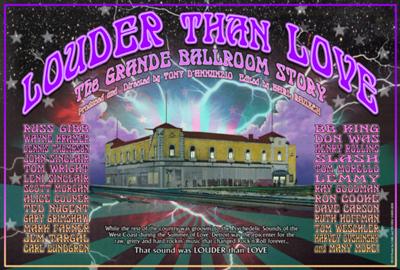
The Grande Ballroom Story - Louder Than Love


LOUDER THAN LOVE—
The Grande Ballroom Story
(Trailer)

LOUDER THAN LOVE is the story of the Grande Ballroom—birthplace of the Detroit rock music scene. Bands like MC5, Iggy & the Stooges, Ted Nugent & the Amboy Dukes, Alice Cooper and many more got their start here. The Grande not only influenced Michigan musicians but inspired bands from all over the U.S. and Europe. Legendary acts like Led Zeppelin, Cream, BB King, Janis Joplin, Pink Floyd and the Who graced the stage at the Grande on a regular basis.

(The last we heard, the producer is still seeking distribution funding for this film.)

Freeform Radio Master—Dave Dixon On WABX

It was 1967 and, if we were lucky, once in a great while we might hear something cool on AM radio—Buffalo Springfield’s For What It’s Worth being a harbinger of what was to come. In the autumn of that year, Detroit’s WABX-FM began broadcasting The Troubador, an experimental show, for an hour each week.

For the first time we could listen to an eclectic mix of blues, rock, folk and jazz all within the same program. And in stereo, no less. Within six months the X was broadcasting similar programming for most of each day. For this listener, there was never any looking back at the limited, uneven, preformatted AM station offerings we had had to endure up to that point. (Remember the Zombies being followed by Percy Faith?)

As an impressionable 15-year-old music hound, I would frequently call and have lengthy conversations with the DJs while ostensibly doing homework. John Small, who soon moved over to WKNR-FM, was always very welcoming. Then ABX added Dave Dixon to its staff; he would go on to become the esteemed leader of the legendary "Air Aces."

Dixon had a “golden ear,” introducing attentive listeners to cross-cultural music on a world scale. Only on his show could one be exposed to such gems as Paul Horn’s Inside the Taj Mahal, Gandharva from Beaver & Krause, Richard Harris singing MacArthur Park and Harry Nilsson’s The Point (a complete LP side). In between, he might have mixed in a cut from John Mayall’s Blues From Laurel Canyon, some Savoy Brown (with original vocalist Chris Youlden), Cat Mother & the All-Night Newsboys and a track from Tim Buckley’s Happy Sad release. Toss in some Brian Auger Trinity (featuring Julie Driscoll on vocals) and Laura Nyro singing Eli's Coming for good measure. Not to be overlooked, Detroit artists such as Frost (Dick Wagner), the Amboy Dukes (Ted Nugent), SRC and the Stooges (Iggy Pop) would also be integrated into the mix.

Continued...
Often Dixon wouldn’t play an entire track. Instead he would seamlessly blend portions of disparate genres into a cohesive audio excursion that might last an hour, interrupted only for a FCC-mandated station ID break. His instrument was comprised of matching turntables, a mixing console and a headphone set.

I miss the days when I was INFORMED [about] new
music… even the music I didn't like I grew to appreciate
for its uniqueness. It was truly an education back
then… How will [this generation] expand [its musical]

horizons?? Surely not from corporate radio stations.

Smogboy, from At Detroit forum, 12/10/06

During his career Dixon was fired from more than one station, being labeled as gruff and argumentative. While that very well may be true, to this listener—and frequent caller—he always had time to talk about music, share what he knew, and be an encourager. This was perhaps most important, for I had started on a voyage of musical discovery long before Dave Dixon and WABX, and wondered why others didn’t seem to find music as important to their daily existence. Instead of snuffing out that desire, his unique ability as audio interpreter, alchemist and promoter fortified my quest to be ever on the alert for recordings of interest.

Today the closest one can get to freeform programming in this style rests with college radio stations having limited range, unless they're also streaming on the Internet such as WNMC in Traverse City, Michigan. While it doesn't quite match Dixon's artistry, the Internet's Radio Paradise does a credible job of filling the void left by the demise of freeform terrestial radio. (Albeit Dixon's shows were sometimes extraterrestial.)

Dixon left ABX in 1974. After 10 years in the Miami/Ft. Lauderdale market, he returned to Detroit, where for several years he played the same type of unique music mix on public station WDET as he had during those heady days of the “Air Aces.”

Listen to a 1990 Dave Dixon aircheck while he was on WDET:

After a few years doing a talk show on WXYT in Detroit, Dixon died at home in May of 1999 at age 60. His legacy is that of programming shows in the way that a painter chooses colors and textures, painstakenly and deliberately applying them on an aural canvas to provide much more than a fleeting impression.

Pharoah Sanders Quartet In Concert At Yoshi's

Regular Floydian Slips readers probably know we've been lifelong fans of jazz saxophonist Pharoah Sanders since first hearing Upper and Lower Egypt off of his Tauhid release. In 1999 he remarked that, due to his musical pedigree—including a stint in Sun Ra's Solar Arkestra—he had been unable to get sufficient bookings back in America. Sanders is also known for dueling horn-to-horn with the great John Coltrane. Having established all of that, we were ecstatic to finally catch up with him in concert.

(Sun Ra's Arkestra had once played Russ Gibb's Grande Ballroom in Detroit at the behest of MC5 manager and White Panther Party founder John Sinclair.)

On this tour Sanders is playing with renowned Indian tabla player Zakir Hussain, who has previously collaborated with guitarist John McLaughlin on his Shakti projects and Grateful Dead drummer /percussionist Mickey Hart on several ethnomusicology endeavors. In 1991 a Planet Drum collaboration of Hart and Hussain's won a Grammy Award in the then-new Best Contemporary World Music Album.

We're fans of McLaughlin and Hart, but—not having heard too many Shakti and no Planet Drum recordings—didn't know Hussain. But two friends, Ram and Bharath, knew Hussain's music well in their home country of India, where Hussain is also a musical producer, film actor and soundtrack composer. To make things interesting, neither had ever heard of Sanders prior to joining us at Sunday's concert.

[He's] probably the best tenor player in the world.

Ornette Coleman

Bharath: I read up about Pharoah Sanders and his music on the the Internet prior to the event. Zakhir Hussain is a legend who is peerless when it comes to playing the tabla. It was because of him that I was really looking forward to the event. I wasn't sure how well Hussain and Sanders would come together playing their instruments, since it seems difficult to blend tabla music in a jazz setting. Once the concert started, it became difficult to appreciate Hussain's tabla whenever Sanders was playing. Whenever the saxophonist took breaks, however, Hussain and the rest of the ensemble were able to highlight their music. Hussain was both really energetic and innovative (using different instruments), but I left with the impression that his strength is still Hindustani or Carnatic music and not really fusion music (at least not in the jazz realm). Overall he was much better performing solo or with drummer Joe Farnsworth in this context.

Listen to these Pharoah Sanders' tracks in their entirety:

ThembiAstral TravelingUpper & Lower Egypt

Ram: I'd never seen the great percussionist Zakhir Hussain perform, but every kid in my neighborhood knew of him growing up—initially through Taj Mahal tea ads, then later by listening to him on the radio and TV. I was intrigued with the notion of jazz with tabla, not to mention a trip to the city and sushi on top of that. Yoshi's is cozy yet not too small, providing a great view from almost anywhere in the house. Starting promptly at 2 pm, after ten minutes into the matinĂ©e Sanders left the stage and each sideman got a chance to solo. Upon returning, Sanders took to vocals and his sax, inviting the audience to sing and clap to music that was absolutely captivating. He even danced on occasion! The only difficulty was in hearing Hussain's tabla, which was almost inaudible during this portion. After this the musicians soloed again, followed by a jugalbandi between Hussain and Farnsworth. All in all the show was fantastic; the only downside being that it perhaps ended too early.


Chris: Pharoah Sanders could do no wrong. If all I was able to do was to say hello and let him know of my passion for his music since first hearing it 40 years ago, that would have been sufficient. Two nights prior to the concert, I streamed a film about Neal "On the Road" Cassady from Amazon. What did the producers choose as a music bed for one scene but Sanders' Upper & Lower Egypt, from the same Tauhid album that willingly pulled me in to his music. In the way that consciousnesses inexplicably converge, I truly sensed some foreshadowing going on.

Having heard "Toots" Thielemans at the original club in Oakland, I was enthralled just to be at Yoshi's in San Francisco on a sunny Sunday afternoon. Not only did Sanders' oblige with a pre-concert photo of the two of us, I know I was smiling throughout his performance. One moment he's very melodic, then he honks a note or two reminiscent of a charging rhinoceros. A tip 'o the hat also goes to William Henderson, who provided oustanding accompaniment on piano.

Clapton, Winwood Play Madison Square Garden

Having seen Cream play at Detroit's Grande Ballroom in the autumn of '67, like many fans I was disheartened when they disbanded. Also being a fan of Steve Winwood's Traffic, my excitement was quickly renewed when I learned that Eric Clapton and Ginger Baker were teaming up with Winwood to form Blind Faith. Their one and only album shortly hit the streets in August of '69.

That fall I saw them at Olympia Stadium (then home of the Red Wings)—the worst venue ever at which to stage a concert of any sort. The warm-up acts that night included one-hit wonders Friend & Lover (Reach Out of the Darkness), followed shortly by Delaney & Bonnie and Friends. Yes, I had reserved seats, but because the stage was set "center-ice," mine faced the rear of the band's speaker columns! Only on occasion would my heroes duck around between their Marshalls to play a few bars for us poor sods relegated to the "low-rent district." (As the promoter of this fiasco, you owe me one, Russ!)

With the exception of paying the big bucks to see Paul McCartney at "Echo" Arena a few years back in Sacramento, I've managed to steer clear of the large indoor "concert venues"—instead enjoying arena rock on my 52" video/surround sound system. So preferring my couch-potato venue for the really big acts, to my delight Steve Winwood was the featured end-of-show performer at Clapton's 2007 Crossroads benefit concert held outside of Chicago. First performing many of Traffic's chestnuts as a frontman, he then teamed up with the concert host to perform several Blind Faith numbers.

I had seen advertisements for the current Clapton~Winwood concert tour online, but had no idea—until today—that a DVD release of their February Madison Square Gardens tour stop was in the works. Among many others, tracks include Had To Cry Today, Dear Mr. Fantasy, Pearly Queen, Tell the Truth, After Midnight, and Voodoo Chile (for which Winwood played keyboards on Hendrix's original Electric Ladyland release).

PBS will be broadcasting this terrific performance in June, so check your local TV listings. Below is an amateur video from that event featuring the rocks legends' version of Hendrix's Little Wing. While it gives you an idea of what to expect from both the video and any forthcoming live concert of theirs, please remember that this sample is not at all representative of the quality provided by the authorized DVD. Enjoy!


Tim Buckley & The Grande: Motor City's Burnin'

In the turbulent summer of July, 1967, folksinger and Elektra recording artist Tim Buckley was booked to play Detroit's Grande Ballroom, run by "Uncle" Russ Gibb. Back in the day, it was not uncommon for musicians to accept Gibb's invitation to stay at his place while in town. So it was that Buckley and his Afro-American drummer, Carter Collins, found themselves at a Sunday picnic organized by their host and held at Kensington Metropolitan Park (to the northwest of Detroit along I-96).

Returning from their day outing, the three surprisingly found the streets blocked when they got to the intersection of Greenfield Road and Grand River Avenue. It was then that the police informed them that parts of the city were in flames, that it was unsafe to proceed past the boundary at Eight Mile Road that had been established by the National Guard.

"Holy crap," Buckley and Collins exclaimed, "We need to fetch our gear from the Grande!" All three knew that the venue was located near ground-zero and could possibly be torched. Collins had stashed his drum kit there, while Buckley had left a few priceless guitars.

Russ being the local, he circuitously navigated his Thunderbird first through the white neighborhoods, then on into those which were primarily black. At this point Collins took the wheel, with Buckley and Gibb crouched down very low between the front and rear seats.

Now approaching the Grande, Collins flagged down a young black kid and—the ballroom being unscathed amongst the flames everywhere else—pointed to the Grande. "Hey, man...what's going down? How come that place still standin'?" The young boy replied, "Oh, dey got MU-sic dere."

So it was that the Grande Ballroom—having hosted such acts as Muddy Waters, Albert King, (Detroit's own) John Lee Hooker, Howlin' Wolf, B.B. King, Buddy Guy, the James Cotton Blues Band, and the Chambers Brothers—escaped the infamous '67 riots. It was a regular protocol—long established by Gibb—to let the local black kids in for free. He had figured that if they were inside enjoying themselves, they weren't outside breaking into patrons' cars and/or accosting concert-goers outside the venue.

"Uncle" Russ Revisits The Grande Ballroom


Left: Russ back in the day


Below: Russ talks about the Grande Ballroom in these two videos (click
to play).


Led Zeppelin: "Roadwork" Visits The Grande

Probably one of the best books about rock 'n' roll you'll ever see.Pete Townshend

Shortly after WKNR's owner, Nellie Knorr, passed away, I got one of those "blue sky" phone calls from "Uncle" Russ Gibb (the latter being chronicled elsewhere in this blog). Among the topics of discussion was Russ' mentioning to me of Tom Wright's terrific photojournal, Roadwork—Rock & Roll Turned Inside Out.

Wright was the official photographer of The Who's first couple of U.S. tours, that group having debuted their Tommy rock opera at Russ' Grande Ballroom in Detroit. When one early tour came to an abrupt end, Tom returned to the Grande to take a turn as its manager. Later, he was instrumental in constructing the buildings for Richard Songer and Russ' Goose Lake International Music Festival (for which I serendipitously served on the film crew). Later, Wright toured with and photographed other rock groups, including Rod Stewart & the Faces.

One very amusing story came out of Wright's stint at the Grande, involving the "The New Yardbirds" (you may know them as Led Zeppelin). Surf over to this National Public Radio site, where you can also hear an interview with Wright. The story I allude to is further down the page and is entitled, Chapter 17: The Grande.

Soft Machine Upstage Jimi Hendrix

Room Full of Mirrors (Slight Return)

This is an e-mail I sent to author Charles Cross in 2006 while reading his Room Full of Mirrors: A Biography of Jimi Hendrix:

"This is an interesting book. I picked it up to learn more about Jimi's relationship with Miles Davis, of which there are differing accounts of what actually transpired. In Miles' own autobiography, he never mentions the three-way deal with Jimi and Tony Williams, but only tells how they were due to get together on a project immediately after the Isle of Wight. Of course, I believe Miles may have conveniently omitted the business of wanting $50K from Mike Jeffrey before moving ahead with the Miles-Jimi-Tony project mentioned in your book.

"The Jimi at Cobo Arena (Detroit) concert, sponsored by radio station 'Paul Is Dead' WKNR, apparently took place in November of '68. I had seen the Experience at Detroit's Masonic Auditorium, with Soft Machine (also managed by Jeffrey), nine months prior. Jimi was having one of his off nights, was in a foul mood, and there was no encore, as I recall. I was extremely disappointed in his performance that evening.

"On the other hand, Soft Machine absolutely blew me away, between their music and fabulous light show. In letting "Uncle Russ" Gibb know how much I enjoyed that group during one of my regular calls to him while he was on the air, he invited me down to Keener in Dearborn [MI] to pick up an advance copy of their debut album on a 7" tape reel. This I did, with that story being chronicled at the above-referenced URL [and as an earlier blog entry].

"I haven't yet read the final chapters and the story of Monika Danneman. If you subscribe to Eric Burdon's theory laid out in his memoir, she was a psycho who dosed Jimi with extremely powerful German painkillers in an effort to keep him in her nest. Burdon also had issues with Mike Jeffrey regarding his mob ties, both in the U.S. and U.K."

[Interestingly, I recently learned that Andy Summers, guitarist with the Police, had been both a one-time member of Eric Burdon's New Animals and Soft Machine. Alas, he had been sent packing from Soft Machine before their Hendrix support tour got underway, so I've never had the opportunity to hear him play live.]

Detroit Rock: Dick Wagner, Alice Cooper & Friends

Here Comes the Mystery Man

Several weeks ago I was listening to Radio Paradise when the station proprietor and chief musicologist, Bill Goldsmith, mentioned guitarist/singer/composer Dick Wagner in connection with Lou Reed. "That's interesting," I thought, thinking I might drop Bill a quick note about my Dick Wagner connection. One gets busy, though, and...

Fast-forward a week or so. Radio being what it isn't these days (no thanks to Clear Channel), I usually listen to NPR in the car and happened upon an immediately-identifiable voice—that of one Alice Cooper, progenitor of Kiss, Marilyn Manson, and the Rocky Horror Picture Show. Later, I remembered that Dick Wagner was Alice's guitarist and co-conspirator for many years.


(Not being an Alice fan back then, the interview was both fascinating and enlightening...did you know Alice personally knew the likes of Groucho Marx, who was a fan? I didn't either. Click the [Listen] button to hear the interview.)

My first personal encounter with Wagner was at a concert at the Birmingham (MI) Palladium, where a group of us were chatting him and his band up during a break. We had also seen his group, The Frost, in addition to ("Terrible" Ted Nugent's) Amboy Dukes, the Psychedelic Stooges (read: Iggy Pop), Bob Seger, et al., appear as warm-up acts all over SE Michigan. (Seger even performed at our surprise high school assembly one afternoon, debuting his Beautiful Loser LP).


From Dick we quickly learned The Frost would soon be recording their second LP, Rock 'N' Roll Music, live at the Grande Ballroom, Detroit's Fillmore-equivalent run by Russ "Paul Is Dead" Gibb. In fact, most of the aforementioned bands, including the MC5 and an earlier group that featured the Eagles' Glenn Frey, were in semi-rotation as opening acts at the Grande.

Shortly thereafter, I well remember pushing my way forward through the Grande's SRO crowd, then proceeding to scream my fool head off at the end of each song. It was a live recording, after all, and they had asked us to make it sound that way. Coming across these recordings not long ago, I swear I can still hear my distinctive "w-h-o-o-p"!


With minimal guidance from Grande artist Carl Lundgren (Gary Grimshaw was the other regular artist), it happens I also designed a postcard (now a collector's item going for $250 a copy), promoting an upcoming B.B. King appearance at the Grande, on which both Wagner's Frost and Iggy's Psychedelic Stooges are billed as opening acts. Imagine this handbill appearing as a part of a regular B.B. King exhibit at the Rock 'N' Roll Hall of Fame & Museum (true story)!

In visting Wagner's well-done
website, one learns he moved to Phoenix a couple of years ago and once again is teamed up with Alice Cooper preparing some new material. Hoping to see the "Mystery Man" again soon!

Paul Is Dead During Magical Mystery Tour

Rapping With Russ

Being an ever-faithful listener of "Uncle" Russ Gibb's WKNR-FM classic rock show (back in the gool ole days!), I was captivated one weekend when he interviewed a fellow on-air about multiple clues, taken from many Beatles' LPs, leading to the possibility that Paul McCartney had been killed and replaced by a look-alike. Though I don't specifically remember what tips I contributed, I was very excited to be able to participate in Russ' show and offer additional "clues," now that pandora's box had been opened.

Stories such as these, including the one about having seen each of the Beatles shows on the Ed Sullivan Show, have been passed down to my two kids. My wife, of course, has been subjected to my far-off reminiscences of that era more times than she cares to remember. So it was the four of us met in London in August, 2001. On the alert for a suitable birthday present for Dad, my son arranged for the four of us to go on a guided "Magical Mystery Tour" walk.

Starting very near the location of the Beatles' short-lived Baker Street clothing boutique, the tour takes in McCartney's MPL office, Carnaby Street, and several other Fab Four sites on its way to the former Apple headquarters, where the Fabs, along with Billy Preston, played the famous "Get Back" rooftop session.

From there it was on to the world famous Abbey Road Studios in St. John's Wood, where our guide launched into a dissertation on the famous zebra-crosswalk photo appearing on the cover of the Beatles' last album, Abbey Road, prior to disbanding. Here Paul is pictured barefoot and a VW license plate reads, "28IF," Paul's age at the time of the infamous KNR broadcasts "had he lived." My ultimate delight came from the astonished looks on the faces of my wife and kids when, after explaining many of the clues, our guide attributed the "Paul Is Dead" story to none other than "Uncle" Russ, my WKNR-FM disk jockey friend (and Grande Ballroom proprietor)!


For the definitive read on all of this, and what part former Grand Funk manager Terry Knight had to do with all of it, check out Andru Reeves' Turn Me On, Dead Man: The Beatles and the "Paul-Is-Dead" Hoax.

Leon Russell, Frank Zappa, Iggy Pop & Friends

And So We Get Started...

This blog is about music...many genres of music, as it happens, though I'm not predisposed to country nor rap. I'm a bit old-school, but you'll find my tastes are all over the place—from John Coltrane to Hoyt Axton, Roy Orbison to Vivaldi, Diana Krall to Blue Oyster Cult.

That's not to say that I don't appreciate an occasional offering from an Alan Jackson or a M.C. Hammer (like I said, I'm a bit old school), but don't expect to learn anything about the latest alt rock by reading any of this. Once in a while I may let my fondness for some group like Porcupine Tree, the Doves, or Durutti Column be known, but unless I get tipped off by (the best thing to happen to Internet radio), or by my daughter, Brooke, I don't spend much time chasing that down. Sorry. There are only so many hours in the day in which to listen.

Rather, I'm writing this blog to hopefully broaden your own audio spectrum: to perhaps turn you on to some obscure piece of music that's really going to do it for you. Like anything recorded by Yulara. But I'm getting way ahead of myself.

Along the way, I intend to provide you with some historical background—as much as I care to, that is. For example, that the record companies originally told George Benson to, as the title of an unrelated Frank Zappa recording attests, Shut Up 'N Play Yer Guitar. They believed that no one would ever want to hear poor George sing and, thankfully, they were very wrong.

(Though you've probably heard George's rendition of The Drifters' On Broadway by now, check out his version of Leon Russell's This Masquerade. And now that I've mentioned Leon, were you aware that it was he who penned This Diamond Ring, a big Top 40 hit for Gary Lewis & the Playboys? And yes, Gary is the son of Jerry Lewis, the goonier half [?!] of the Martin & Lewis comedy team. It turns out that, way before Joe Cocker and Mad Dogs & Englishmen, ol' Leon was a L.A. studio musician playing with the likes of some guy by the name of Glen Campbell.)

See? That's the kind of historical stuff I'm going to be weaving through this blog. Along with ideas for some really cool segues (track mixing) you probably wouldn't have ever considered. We'll talk about gear, from semi-audiophile stuff all the way down to the smallest flash-based MP3 players—though it is not my intention to compete with the likes of Sound and Vision magazine or Engadget.

And I'll relate some personal stories, such as going on a school-sanctioned field trip to see/hear Cream the first time they played Detroit in 1967. Or having Iggy Pop (aka Iggy Stooge) lick my Kodak camera lens. Or catching an early Grand Funk Railroad (subsequently forced to shorten their name to Grand Funk) at an outdoor summer festival at Mt. Holly (near Flint, MI).

But wait! Did someone mention the blues? And jazz? Zydeco? Ambient/trance/acid jazz, et al.? And a whole lot of other stuff? Writing this on a PC holding well over 27,000 processed tracks stashed on 1TB RAID5 disk array (and easily twice that many that have yet to be "processed"), I think I've got the subject covered, though I know of a couple of guys whose collections dwarf mine.

Happy listening!