Showing posts with label Radio paradise. Show all posts

Freeform Radio Master—Dave Dixon On WABX

It was 1967 and, if we were lucky, once in a great while we might hear something cool on AM radio—Buffalo Springfield’s For What It’s Worth being a harbinger of what was to come. In the autumn of that year, Detroit’s WABX-FM began broadcasting The Troubador, an experimental show, for an hour each week.

For the first time we could listen to an eclectic mix of blues, rock, folk and jazz all within the same program. And in stereo, no less. Within six months the X was broadcasting similar programming for most of each day. For this listener, there was never any looking back at the limited, uneven, preformatted AM station offerings we had had to endure up to that point. (Remember the Zombies being followed by Percy Faith?)

As an impressionable 15-year-old music hound, I would frequently call and have lengthy conversations with the DJs while ostensibly doing homework. John Small, who soon moved over to WKNR-FM, was always very welcoming. Then ABX added Dave Dixon to its staff; he would go on to become the esteemed leader of the legendary "Air Aces."

Dixon had a “golden ear,” introducing attentive listeners to cross-cultural music on a world scale. Only on his show could one be exposed to such gems as Paul Horn’s Inside the Taj Mahal, Gandharva from Beaver & Krause, Richard Harris singing MacArthur Park and Harry Nilsson’s The Point (a complete LP side). In between, he might have mixed in a cut from John Mayall’s Blues From Laurel Canyon, some Savoy Brown (with original vocalist Chris Youlden), Cat Mother & the All-Night Newsboys and a track from Tim Buckley’s Happy Sad release. Toss in some Brian Auger Trinity (featuring Julie Driscoll on vocals) and Laura Nyro singing Eli's Coming for good measure. Not to be overlooked, Detroit artists such as Frost (Dick Wagner), the Amboy Dukes (Ted Nugent), SRC and the Stooges (Iggy Pop) would also be integrated into the mix.

Continued...
Often Dixon wouldn’t play an entire track. Instead he would seamlessly blend portions of disparate genres into a cohesive audio excursion that might last an hour, interrupted only for a FCC-mandated station ID break. His instrument was comprised of matching turntables, a mixing console and a headphone set.

I miss the days when I was INFORMED [about] new
music… even the music I didn't like I grew to appreciate
for its uniqueness. It was truly an education back
then… How will [this generation] expand [its musical]

horizons?? Surely not from corporate radio stations.

Smogboy, from At Detroit forum, 12/10/06

During his career Dixon was fired from more than one station, being labeled as gruff and argumentative. While that very well may be true, to this listener—and frequent caller—he always had time to talk about music, share what he knew, and be an encourager. This was perhaps most important, for I had started on a voyage of musical discovery long before Dave Dixon and WABX, and wondered why others didn’t seem to find music as important to their daily existence. Instead of snuffing out that desire, his unique ability as audio interpreter, alchemist and promoter fortified my quest to be ever on the alert for recordings of interest.

Today the closest one can get to freeform programming in this style rests with college radio stations having limited range, unless they're also streaming on the Internet such as WNMC in Traverse City, Michigan. While it doesn't quite match Dixon's artistry, the Internet's Radio Paradise does a credible job of filling the void left by the demise of freeform terrestial radio. (Albeit Dixon's shows were sometimes extraterrestial.)

Dixon left ABX in 1974. After 10 years in the Miami/Ft. Lauderdale market, he returned to Detroit, where for several years he played the same type of unique music mix on public station WDET as he had during those heady days of the “Air Aces.”

Listen to a 1990 Dave Dixon aircheck while he was on WDET:

After a few years doing a talk show on WXYT in Detroit, Dixon died at home in May of 1999 at age 60. His legacy is that of programming shows in the way that a painter chooses colors and textures, painstakenly and deliberately applying them on an aural canvas to provide much more than a fleeting impression.

"Broadcast" Media From PC To Stereo and TV

Wirelessly Transmit Streaming Media
Through Your House—On the Cheap!

Problem: Your PC is in one room and the entertainment center in another. Your aging stereo receiver isn't Internet-ready and your budget doesn't include a replacement any time soon. For the same reason, purchasing a dedicated hardware component is out of the question, even if there is room in the entertainment center for another box.

And yet you would really like to be able to stream Internet radio, rockumentaries, and other media sources from your PC to your entertainment center.

Solution: Several companies offer an inexpensive transmitter/receiver package that can "broadcast" both video and a stereo audio signal between rooms. These are easy to install and generally work very well—easily pushing the signal through walls. Although there are several from which to choose, one such system is the AVS-5811 from RF Link (pictured), which is under $120. Savvy eBayers might pay much less.

Such transmitter/receiver sets deliver the A/V signals using radio frequencies (RF differs from infrared, the latter requiring an unobstructed line of site and offering limited distance). The RF Link AVS-5811 operates in the 5.8 GHz range, where wireless phones and microwave ovens won't cause interference. It also has four channels from which to select in the event that something else in your home causes interference. (Whichever channel you use, make sure that both the transmitter and receiver are set to the same one.) And although a clear line-of-site is not required, the RF Link AVS-5811 boasts a 300 foot transmission distance in such installations.

Audio: You'll need to purchase of some inexpensive adapters to hook up the transmitter to your PC. The red and white audio leads require a single female stereo RCA-to-male 1/8" mini-plug adapter, about $2. Connect the male end to the audio out jack on your PC's sound card, usually located at the rear of the PC chasis and color-coded light green on recent-vintage computers. Match up the red and white female RCA leads of the adapter with the corresponding male cables on the RF transmitter.

Now connect the red and white male RCA leads from the RF receiver to an unused set of RCA inputs on the back of your stereo receiver (except those marked Turntable). The inputs marked Tape 2 Record would be a good choice.

To listen to Internet radio, first access the audio source on your PC. You'll want to control the final volume level from your stereo receiver, not your PC, so set the PC volume to be sufficiently loud. Now select the Tape 2 Monitor input source (often labeled "Mode") on your stereo receiver. You should now be hearing your Internet audio source and, if this is all you want to do, you're all set. See the summary below.

Video: Transmitting video from your PC to TV is a bit more involved. First, it's best if your TV is of recent vintage and includes auxiliary inputs either on the front or rear of the set. These provide a better quality picture. If your TV is not so-equipped, purchase a simple RCA-to-coax adapter for a few dollars. It is to be connected between the yellow video cable of the RF receiver and the coax antenna input on the TV. (The picture quality may or may not be to your liking in this scenario.)

Continued...
On the PC side of this setup, we're going to assume your PC video subsystem doesn't presently offer an S-video output on the rear of the computer chasis (if it does, skip to the next paragraph). If this assumption is true, the least expensive way to convert your PC video is to replace the present video subsystem with an adapter card that includes an S-video port. There are many, but a quick Internet search turned up a PNY GeForce FX 5200 256MB VGA card for under $50.

A few more dollars gets you a male S-video to female RCA adapter, which you'll need to connect the RF transmitter's yellow cable to the PC's S-video output. On the RF receiver side, simply plug its yellow composite video cable into the matching colored RCA receptacle on your TV. Here you will most likely have to select a video input mode on the TV, similar to when you watch a DVD or VHS video tape.

Summary: None of this is rocket science, with the possible exception of replacing your PC video subsystem. Get a knowledgeable friend to help. Beyond this portion of the project, your local electronics retailer (Radio Shack, Best Buy, et al.) can help you. Cables To Go is also an excellent source for online chat help as well as for purchasing most of the requisite adapters.

Streaming media aside, we should also mention that RF transmitter/receiver sets such as the RF Link AVS-5811 can be used for other applications when not being used to transmit streaming media. A common example is in the simultaneous viewing of video programs on a second TV/monitor without use of any wires. Another is the ability to relay any indoor audio source to a set of self-amplified speakers positioned outdoors.

Maximizing (Non-iPod) MP3 Player Capability

Many people, including me, were enjoying MP3 players long before "iPod" became synonymous with any portable device that plays compressed digital audio files. My first player was a CD clamshell player-sized unit from Creative Labs. At the Tom's Hardware website I quickly learned how to replace its original 20MB harddisk with a drive having twice that capacity. And it being a first-generation device not without an occasional problem, from eBay I was able to buy inexpensive spares to keep my unit—and those of friends—functioning.

Anyone who knows me knows that I'm not an Apple fan, primarily because the company has long had a policy of über-control over anything that bears the company brand. While that has certain advantages in relation to computer operating systems, it doesn't do much for those given to customization. There are other reasons, too, why there is a community of like-minded folks who won't have anything to do with Apple, just as there are those who aren't fond of Microsoft. But back to MP3 players...

J&R Computer/Music World

The Anything But iPod website is run by like-minded individuals; I've been a fan of this website for years. As the name implies, everything here is about all of the other personal media players (PMPs) on the market. For example, check out their MP3 Player Buyer's Guide. Anything But iPod dedicates itself to PMP news, reviews of players and ancillary gear such as headphones and amplifiers, and even hardware hacks for the do-it-yourselfer.

Back in the good ol' days, there were two things that excited me most about listening to great radio stations such as Detroit's WABX (the station that glowed in the dark). The first was their dedication to playing music from multiple genres in a seemingly random, but well-coordinated manner (this is what Radio Paradise does on the Web). Today just about all PMPs have random—or shuffle—capability, and it's rare that I ever switch to sequential playback mode.

The second feature—crossfading—seems to be far more elusive to most PMP manufacturers. Known as a segue in my own radio days, this is how 'ABX would paint a musical dreamscape, perhaps starting with a selection from Paul Horn's Inside the Taj Mahal, blending into a portion of Peace Two from John McLaughlin's My Goal's Beyond, into Lower Egypt from Pharoah Sanders' Tauhid album, and concluding with a portion of an early Pink Floyd instrumental.

A good segue would...build an idea just as a writer would build on a compositional theme...The FM free-form DJ was carefully selecting each record to...[build] on emotions or themes…

David Benders, WBFO Program Director

Switching to an HP Rx3715 pocket PC (PPC) that I had purchased as a glorified remote control for my home entertainment system, it soon became my PMP of choice with the addition of Conduits Technologies' excellent Pocket Player application. Although not as adventuresome as having "Air Ace" Dave Dixon hand-select audio segments in his unique style, this was a great answer to my desire for MP3 crossfading! (I might still be enjoying this unit had not its headphone jack gerfritzen das springenwerk).

Enter
Rockbox. All open-source code, a dedicated group of hackers (hackers = good, crackers = bad) have created numerous, free downloadable firmware alternatives for many PMPs, such as the first-generation Sansa series players. And guess what? One of the key features of Rockbox is the ability to crossfade tracks. Heck, they even have some firmware replacements for selected iPod models!

Radio Paradise: Eclectic Internet Radio At Its Best

Publisher's Note: After high school, Radio Paradise's Bill Goldsmith worked for a several radio stations in California & Hawaii. While commercial radio degenerated into an überprofit-controlled conglomerate spewing a highly-distilled, homogeneous listening experience in markets across the U.S., Goldsmith had a plan. His idea—not all that unique to those who remember the heady days of "underground" radio in the '60s—was that listeners really wanted audio entertainment provided by an informed "DJ [turned] loose in a music library, with no goal in mind but to ...[create] a seamless flow that [spans] decades, genres, and styles." The Internet is what made Goldsmith's dream viable.

Goldsmith and his worldwide Radio Paradise listeners have turned me on to more new, commercial-free music than I ever would have heard elsewhere. But be patient when sampling RP—being an eclectic mix, there are those times when a few tracks may not be your cup 'o tea. Try again in an hour or perhaps the next day—there is very little on RP that isn't listenable around the clock.

The biggest problem a band has is getting its music heard. For years, the music industry was confined to four multinational corporations that dominated the revenue stream of 70% of the music coming in, and four or five radio conglomerates that controlled what music was going out.

Greg Kot, Ripped: How the Wired Generation Revolutionized Music
Time magazine interview, 5/21/09

Dave Belfer-Shevett at Planet Geek! interviewed Goldsmith in 2004. Although Radio Paradise has greatly changed (for the better) since that time, Floydian Slips thinks you'll find this abridged version of Belfer-Shevett's interview with Goldsmith to still be of interest.

[dbs] Bill, how you got to be the producer of one of the most popular online music stations on the 'Net?

[Goldsmith] I spent the 1990s at...a funky little FM station near Santa Cruz, California called KPIG. We were everything that FM radio had convinced itself that it couldn't be: adventurous, irreverent, creative, and thoroughly unique. We were also wildly successful—regularly out-billing the local Clear Channel stations in spite of the fact that we mostly played music that nobody had ever heard of before, made fun of our advertisers, had a certifiable left-wing nut job as our news commentator, and let the DJs (gasp) pick the music on their own shows.

Continued...

In 1994 I learned a little HTML and built a website for KPIG, and in August 1995 I inaugurated the world's first full time webcast using Xing Streamworks software. It was 16 kBps MP3 (so you can imagine how bad it sounded) and we could only serve about fifty listeners, but I was thoroughly and completely hooked on the idea of Internet radio. I saw it then—and I see it now—as the natural successor to FM, with a worldwide reach and an unlimited number of channels.

In 1999 I left Santa Cruz to relocate to Paradise, [CA] where my wife, Rebecca, owned a house (we were married in 1999) and I spent the next year working as a consultant for KPIG and other stations while I put together the dream project that had been bubbling around in my head for decades: a station of my own—where I could play exactly what I wanted to play and say what I wanted to say, without worrying about what any station owners or advertisers thought. What made it all possible was that magic confluence of technologies called Internet radio.

So, in February of 2000, Radio Paradise was born.

[dbs] How many folks are on your team? I know that you are the Voice of Radio Paradise, and we hear Rebecca on occasion doing spots, [but] are there others that help keep the station going?

[Goldsmith] It's pretty much just Rebecca and [me]. We've been outsourcing our webhosting since the beginning of last year, and we utilize some freelance design help here and there—but other than that it's just the two of us. Rebecca handles all of the finances and is our music reviewer. She spends several hours each day combing through the CDs and music files that we're sent, searching for the stuff that meets our picky standards. I do the music scheduling, DJ breaks, web design, and technical stuff.

[dbs] From the technical side, how does RP produce its shows? Do you come up with your playlist on the fly, a day ahead, etc?

[Goldsmith] That depends. When we're taking time off we can schedule things up to two weeks in advance; other times I'm working just a few minutes ahead of air time. Due to the nature of our setup, the station is never quite "live" in the traditional sense. Everything is preplanned & prerecorded at least five minutes or so ahead.

[dbs] The music industry has always been on the [scale] of large monopolies such as Microsoft and Clear Channel. How do you see the online music industry faring as it gains popularity and attracts the attention of these giants? I point to issues such as proprietary music formats, licensing, and digital rights management systems.

[Goldsmith] The big media conglomerates have been trying to control and dominate the online music space for several years now. I think that eventually they will accept the fact that the rules are just different here—that, for instance, tightly controlling users' ability to freely copy music files will never quite work. They'll need to come to terms with the fact that the monopoly they've enjoyed over the distribution and marketing of music is over. And that for every door that the new technology shuts, two or three others are opened. The idea that the only way the music industry can be profitable is if they restrict access to their product is just flat out wrong. Plenty of people in the industry get this and are already thinking along new avenues. I think we'll see some interesting stuff develop over the course of the next five years or so.

[dbs] Here's a big advertising opportunity. If you had to give the elevator speech about RP to someone who hadn't heard of it before, how would you pitch it?

[Goldsmith] Radio Paradise is the old 1960's progressive-FM philosophy ("put a DJ in a room full of records and turn him/her loose") applied to the whole universe of 21st century music: modern & classic rock, world music, electronica, acoustic, even a smattering of jazz and classical—with a real human DJ in full control, not just an "iPod on random play" jumble of styles. It's radio-as-art, rather than radio-as-marketing—something you just don't hear on FM any more. Try it. It's addictive.

Increase Remote Control Range w/ IR Adapter

Beam Me Up, Scotty

I've been meaning to write about a device I recently purchased for some time. Readers of this blog know that I have a three-zone, 'Net-enabled stereo that permits listening to Radio Paradise, or MP3s from my media server, all over the house. And on the patio.

It was a bother, however, to have to dash inside all the time to either adjust the volume on the patio speakers, change a music source, mute the audio, or any other function. Installing an outdoor volume control would have helped some (and was my original plan), but doing so wouldn't answer the other requirements. Plus, such a control would mean having to get up, or run over from wherever, to manually adjust the volume up or down.

Thinking ahead, I set up the patio speakers on their own separate "slave" amplifier—designated zone 2—with the slave getting its audio feed via a stereo RCA cable to its CD input from the master Yamaha RX-V2700 home theater receiver. And Yamaha was thoughtful enough to include a second remote control that is easily switchable between zones 2 and 3. So far so good, but the zone 2 remote wouldn't work very well from out on the patio due to its native infrared (think line-of-sight) signal.
Looking for a viable solution to extend the distance at which at the controller would function, and simultaneously eliminate the inherent limitations of infrared (IR), a quick Google search led me to Smarthome.com. There I found an adapter (SKU 80451) that, for under $50 (online price), turns any IR controller into a radio frequency (RF) transmitter, sends that signal to a supplied RF base unit (pictured above), then converts the RF back to IR for the short jump to the audio receiver. Smarthome's kit includes everything you need, whether your IR controller accepts AA or AAA batteries.
Now I can control audio outdoors, including instant mute should the phone ring or a service person need to ask a question—at any angle, through the walls, from about 100' away from the base!

The only drawback is that the adapter could benefit from a better set of instructions (a subject close to home, as I write instructions for a living). Though I'm very intuitive around gadgets and can eventually interpret instructions written in Engrish, even I fumbled around for awhile before figuring out how to set it up. So here's the scoop: The cylindrical transmitter, in conjunction with a small rechargeable battery, takes the place of a single battery in your IR controller. The supplementary battery is to be placed within the adapter's base so as to be fully recharged when the first one poops out. Plugged into an AC socket, the base is to be positioned in such a way that its window (from which the IR signal emanates) faces the audio receiver's own IR sensor.

You do not need to buy this particular adapter—there are others on the market. My purpose is to cause you to be aware that a solution does indeed exist to IR line of sight and distance issues. That said, I can attest that this adapter functions well and it was a pleasure doing Internet commerce with SmartHome. Since receiving their catalog along with my order, I've since found several other gadgets that look like they'll solve problems we face, such as knowing for certain whether we've left the garage door open during the course of a day.

Note: Additional adapter base units are available separately for multiple zone use.

Detroit Rock: Dick Wagner, Alice Cooper & Friends

Here Comes the Mystery Man

Several weeks ago I was listening to Radio Paradise when the station proprietor and chief musicologist, Bill Goldsmith, mentioned guitarist/singer/composer Dick Wagner in connection with Lou Reed. "That's interesting," I thought, thinking I might drop Bill a quick note about my Dick Wagner connection. One gets busy, though, and...

Fast-forward a week or so. Radio being what it isn't these days (no thanks to Clear Channel), I usually listen to NPR in the car and happened upon an immediately-identifiable voice—that of one Alice Cooper, progenitor of Kiss, Marilyn Manson, and the Rocky Horror Picture Show. Later, I remembered that Dick Wagner was Alice's guitarist and co-conspirator for many years.


(Not being an Alice fan back then, the interview was both fascinating and enlightening...did you know Alice personally knew the likes of Groucho Marx, who was a fan? I didn't either. Click the [Listen] button to hear the interview.)

My first personal encounter with Wagner was at a concert at the Birmingham (MI) Palladium, where a group of us were chatting him and his band up during a break. We had also seen his group, The Frost, in addition to ("Terrible" Ted Nugent's) Amboy Dukes, the Psychedelic Stooges (read: Iggy Pop), Bob Seger, et al., appear as warm-up acts all over SE Michigan. (Seger even performed at our surprise high school assembly one afternoon, debuting his Beautiful Loser LP).


From Dick we quickly learned The Frost would soon be recording their second LP, Rock 'N' Roll Music, live at the Grande Ballroom, Detroit's Fillmore-equivalent run by Russ "Paul Is Dead" Gibb. In fact, most of the aforementioned bands, including the MC5 and an earlier group that featured the Eagles' Glenn Frey, were in semi-rotation as opening acts at the Grande.

Shortly thereafter, I well remember pushing my way forward through the Grande's SRO crowd, then proceeding to scream my fool head off at the end of each song. It was a live recording, after all, and they had asked us to make it sound that way. Coming across these recordings not long ago, I swear I can still hear my distinctive "w-h-o-o-p"!


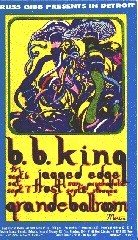
With minimal guidance from Grande artist Carl Lundgren (Gary Grimshaw was the other regular artist), it happens I also designed a postcard (now a collector's item going for $250 a copy), promoting an upcoming B.B. King appearance at the Grande, on which both Wagner's Frost and Iggy's Psychedelic Stooges are billed as opening acts. Imagine this handbill appearing as a part of a regular B.B. King exhibit at the Rock 'N' Roll Hall of Fame & Museum (true story)!

In visting Wagner's well-done
website, one learns he moved to Phoenix a couple of years ago and once again is teamed up with Alice Cooper preparing some new material. Hoping to see the "Mystery Man" again soon!

Audio Gear: Yamaha Home Theater Receiver

Since August the wife and I have been engaged in a 100% top-down remodel while we live amongst the chaos. Tearing the family room down to studs enabled me to install a 7.1 surround sound system, with in-wall speakers and cabinets furnished by Polk Audio. The fronts are Polk LSi7 series speakers, coupled with the biggest, baddest subwoofer Polk offers, the PSW505. Well, OK...it's the biggest and baddest for my price range, their PSW1000 being beyond my reach. (I did have to buy other gear, ya know!)

The star of the show, though, is the new Yamaha RX-V2700 A/V receiver with power to spare, full network capability built-in, and a USB port on its front panel. Slip in any flash drive or flash player loaded with MP3s (or WAVs, what-have-you), and the Yamaha plays them back in series or at random. Attach a large capacity external USB hard drive holding your entire collection, the drive formatted as FAT32, and you never have to fumble with another CD, cassette, or LP ever again! And just for you iPodders, Yamaha sells a compatible docking station.

The Rx-V2700 includes technology to enhance MP3s, "filling in" those lost bits heard in the original format of your songs. Couple that with 7.1 enhanced stereo (the thing is magic, I tell you) and you won't believe just how fantastic your MP3 collection sounds!

Even cooler is how, via DHCP, the Yamaha so easily found its home on my network and discovered the cable Internet connection. (No chocolate mess!) Using the adjacent TV as its display (HDMI), it's a pretty simple matter to navigate 'net radio stations located all over the world and of just about any genre. I was initially concerned that my favorites, Radio Paradise (RP) and KXJZ, would go missing but—lo' and behold—they're listed among the hundreds of choices. Even the wife got excited when I sampled a highly-listenable Christian channel this past Sunday, and she clearly enjoyed hearing The Mavericks (!) on RP tonight (that's just how eclectic RP can be).

The feature I haven't been able to test is the unit's ability to interface with my homebuilt, 1TB RAID5 media server where my MP3 collection resides. This is because the RX-V2700 doesn't support UPnP at this time (c'mon, Yamaha!), instead relying on Windows Media Connect to stream audio from my server. And, of course, the latter requires Windows XP to which I haven't yet migrated my big box. (The unopened OS package is somewhere out in the garage, a.k.a., storage central).

Now, if I could just get the Yamaha and the HP DLP TV to directly interface with J River's Media Center 12...

There Is No Dark Side of the Moon, Really

Mo' Background

Last week I received a bluesky e-mail from a fellow who was trying to track down a former flame—one Kay Seeburg, she of the jukebox family. He had Googled her name and, lo' and behold, up came a post I had made on Radio Paradise in reference to Pink Floyd's Remember A Day. The track is from their second LP, A Saucerful of Secrets, which she thought was the funniest LP title ever. Don't ask me why.

The title of this blog comes by way of the Floyds. Being a HUGE fan of theirs from that LP forward (save for the Animals atrocity), it always amazes me to find listeners—like you, perhaps—who have no inkling of what transpired prior to their epic DSOM (Dark Side of the Moon, for the uninitiated). Sure, that seminal LP sat on Billboard's charts for-freakin'-ever and, though I haven't checked, I'm pretty certain it set Guinness Book records (humor, ar-ar).

So if you have an incination, in addition to the aforementioned Saucerful, may I suggest for your listening pleasure the following: Ummagumma, Atom Heart Mother, and More. The latter is a very obscure soundtrack the Floyd did for a highly-forgettable movie, though their contribution is outstanding. (The Floyds also recorded another soundtrack, Obscured By Clouds, but only overzealous Floyd freaks need track this one down.)

Some of my running buddies also like Meddle, as do I, though I can only listen to the version of Echoes that I edited using Sony Sound Forge. (I understand the track that appears on their Echoes: The Best of Pink Floyd CD by this name is essentially the same as my edited version.)

And for you Netflixers, see if you can spot one pre-Lennonesque Yoko Ono in Pink Floyd: London 1966-1967. This rare footage features the band with founder Syd Barrett, performing a pre-Piper At the Gates of Dawn version of Astronomy Domine, as I recall. Maybe it was Interstellar Overdrive, I dunno. Watch the DVD: you'll enjoy seeing what the mid-60s Carnaby Street crowd was up to after hours.

So if you only know of Pink Floyd by way of DSOM and The Wall, you've got a LOT of terrific listening ahead of you. And David Gilmour's On An Island is also highly recommended!

Wish(ing) You Were Here

Leon Russell, Frank Zappa, Iggy Pop & Friends

And So We Get Started...

This blog is about music...many genres of music, as it happens, though I'm not predisposed to country nor rap. I'm a bit old-school, but you'll find my tastes are all over the place—from John Coltrane to Hoyt Axton, Roy Orbison to Vivaldi, Diana Krall to Blue Oyster Cult.

That's not to say that I don't appreciate an occasional offering from an Alan Jackson or a M.C. Hammer (like I said, I'm a bit old school), but don't expect to learn anything about the latest alt rock by reading any of this. Once in a while I may let my fondness for some group like Porcupine Tree, the Doves, or Durutti Column be known, but unless I get tipped off by (the best thing to happen to Internet radio), or by my daughter, Brooke, I don't spend much time chasing that down. Sorry. There are only so many hours in the day in which to listen.

Rather, I'm writing this blog to hopefully broaden your own audio spectrum: to perhaps turn you on to some obscure piece of music that's really going to do it for you. Like anything recorded by Yulara. But I'm getting way ahead of myself.

Along the way, I intend to provide you with some historical background—as much as I care to, that is. For example, that the record companies originally told George Benson to, as the title of an unrelated Frank Zappa recording attests, Shut Up 'N Play Yer Guitar. They believed that no one would ever want to hear poor George sing and, thankfully, they were very wrong.

(Though you've probably heard George's rendition of The Drifters' On Broadway by now, check out his version of Leon Russell's This Masquerade. And now that I've mentioned Leon, were you aware that it was he who penned This Diamond Ring, a big Top 40 hit for Gary Lewis & the Playboys? And yes, Gary is the son of Jerry Lewis, the goonier half [?!] of the Martin & Lewis comedy team. It turns out that, way before Joe Cocker and Mad Dogs & Englishmen, ol' Leon was a L.A. studio musician playing with the likes of some guy by the name of Glen Campbell.)

See? That's the kind of historical stuff I'm going to be weaving through this blog. Along with ideas for some really cool segues (track mixing) you probably wouldn't have ever considered. We'll talk about gear, from semi-audiophile stuff all the way down to the smallest flash-based MP3 players—though it is not my intention to compete with the likes of Sound and Vision magazine or Engadget.

And I'll relate some personal stories, such as going on a school-sanctioned field trip to see/hear Cream the first time they played Detroit in 1967. Or having Iggy Pop (aka Iggy Stooge) lick my Kodak camera lens. Or catching an early Grand Funk Railroad (subsequently forced to shorten their name to Grand Funk) at an outdoor summer festival at Mt. Holly (near Flint, MI).

But wait! Did someone mention the blues? And jazz? Zydeco? Ambient/trance/acid jazz, et al.? And a whole lot of other stuff? Writing this on a PC holding well over 27,000 processed tracks stashed on 1TB RAID5 disk array (and easily twice that many that have yet to be "processed"), I think I've got the subject covered, though I know of a couple of guys whose collections dwarf mine.

Happy listening!